
Introduction
Modern oilfield operations, and their extensions to clean energy applications, entail the use of a range of well architectures and completion styles applied to reservoirs with variable rock and fluid properties. Today’s energy professionals require simple-to-use tools that enable rapid and accurate evaluation and forecasting of these wells and assist in development planning for new wells. Critical asset development decisions are based on this process and Predico is here to help!
Advanced Flow Analytics (AFATM) provides an array of modern reservoir characterisation and production forecasting tools in an integrated platform that applies the latest developments in automation and data science. Advanced forecasting methods can be simply applied and used on a regular basis by your existing staff with initial setup of these sophisticated tools being optionally supplied by Predico as a service.
Physics-based and automated rate-transient analysis methods, such as flowing material balance (FMB) and dimensionless type-curve analysis, allow for rapid and accurate characterization of reservoir/fracture properties and fluid-in-place estimates (P90, P50, P10 scenarios provided). Physics-based and automated history-matching and forecasting models allow the translation of these property estimates into confident forecasts (P90, P50, P10 scenarios provided).
If empirical forecasting is required, we have you covered. Our data-driven decline-curve analysis (DCA) methods yield best-in class empirical forecasting ability (P90, P50, P10 scenarios provided).
The figure below shows all modules available for AFA’s users.
Come explore our platform and get started with AFA today.
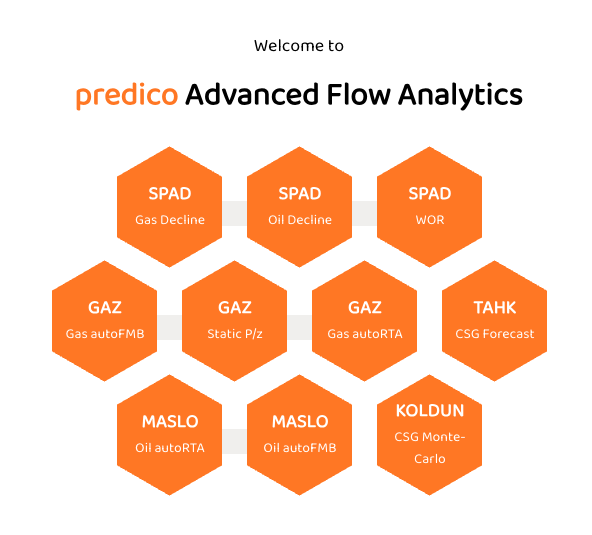
The modules shown above are separated based on the type of analysis provided.
SPAD Modules
SPAD modules use empirical methods such as Decline Analysis and Ratio Analysis, combined with automation powered by unsupervised cluster analysis and other data-driven techniques. They can also generate three sensitivity cases (P90, P50, and P10) using statistical procedures applied both to the overall dataset (called profile forecast) and to automatically identified trends (called operational forecast). The data requirements for SPAD modules vary depending on the module and are listed in the table below. For more details about SPAD modules, please see https://predico.atlassian.net/wiki/x/FgAsE.
|
SPAD Modules |
Data Requirements |
|---|---|
|
SPAD Gas Decline |
Dates, Gas Rates / Gas Volumes |
|
SPAD Oil Decline |
Dates, Oil Rates / Oil Volumes |
|
SPAD WOR |
Dates, Oil Rates / Oil Volumes and Water Rates / Water Volumes |
GAZ and MASLO Modules
The GAZ and MASLO modules use physics-based models that rely on fundamental physical laws to simulate fluid flow, predict reservoir behaviour, and evaluate well performance. These models apply mathematical equations derived from conservation principles (e.g., mass and/or energy balance), as well as physical laws such as Darcy’s law and PVT analysis, to represent fluid flow through porous media.
-
GAZ modules are subdivided into three approaches:
-
Flowing Material Balance (AutoFMB)
-
Rate Transient Analysis (AutoRTA)
-
Static P/z Analysis
-
-
MASLO modules include AutoFMB and AutoRTA, but do not include Static P/z analysis.
To use these modules, users must provide key inputs related to reservoir and wellbore characteristics. The table below lists some of the main required inputs.
|
GAZ and MASLO Modules Input Section |
Inputs Requirements |
|---|---|
|
Reservoir Parameters |
|
|
PVT |
|
The data requirements for GAZ and MASLO modules vary depending on the module and are listed in the table below.
|
GAZ and MASLO Modules |
Data Requirements |
|---|---|
|
GAZ AutoFMB and AutoRTA |
Dates, Gas Rates / Gas Volumes. It is highly recommended that users provide at least one pressure source, such as:
However, these modules are flexible enough to operate without a measured pressure source. In such cases, the user can provide an estimated tubing, casing, or flowing pressure, which AFA will treat as a constant value throughout the entire production period. |
|
GAZ Static P/z |
No data is required. |
|
MASLO AutoFMB and AutoRTA |
Dates, Oil Rates / Oil Volumes.
|
The GAZ and MASLO modules can generate three sensitivity cases (P90, P50, and P10) using statistical procedures through the tuned parameters based on each module:
|
GAZ and MASLO Modules |
Reservoir Characterisation Parameters (tuned parameters) |
||||||||||
|---|---|---|---|---|---|---|---|---|---|---|---|
|
GAZ and Maslo AutoFMB |
|
||||||||||
|
GAZ and Maslo AutoRTA |
AutoRTA modules can also provide extra information of the reservoir depending on the type of model chosen, for example:
|
||||||||||
|
GAZ Static P/z |
|
For more details about GAZ and MASLO modules, please see https://predico.atlassian.net/wiki/x/EAA0E.
TAHK Module
This module implements a tank model designed for Coal Seam Gas (CSG), shale gas, or conventional gas reservoirs. The AFA tank model uses a simplified mathematical representation of the reservoir, assuming uniform average properties and ignoring spatial variations. In this approach, the reservoir is treated as a single, well-mixed tank, averaging key parameters such as pressure and saturation.
The model integrates mass conservation principles, Darcy’s Law, PVT analysis, and adsorption isotherms to simulate reservoir and fluid behaviour during production. It operates under the Pseudo-Steady-State regime (PSS Models) and can be configured for either single- or multi-layer systems. When modelling multi-layer systems, crossflow between layers is accounted for.
To use this module, users must provide key inputs related to reservoir, wellbore, and isotherm characteristics. The table below lists some of the main required inputs.
|
TAHK CSG Modules Input Section |
Inputs Requirements |
|---|---|
|
Reservoir Parameters |
|
|
Relative permeability |
|
|
PVT |
|
|
Isotherm |
|
This module can be used in two modes:
-
What-if scenarios: No input data is required. For guidance, see How to use TAHK CSG in a https://predico.atlassian.net/wiki/x/EwBVIg
-
Reservoir characterisation: Requires input data. The minimum data requirements are outlined in the table below.
|
TAHK Module |
Data Requirements |
|---|---|
|
TAHK CSG |
Dates, Gas Rates / Gas Volumes. It is highly recommended that users provide at least one pressure source, such as:
However, these modules are flexible enough to operate without a measured pressure source. In such cases, the user can provide an estimated tubing, casing, or flowing pressure, which AFA will treat as a constant value throughout the entire production period. Water Rates / Volumes are not mandatory. However, water rates/volumes are highly recommended for 2P CSG cases (where it can be used for constraining relative permeability and fracture pore volume) . |
For more details about TAHK module, please see https://predico.atlassian.net/wiki/x/QAD0Ag.
KOLDUN Module
KOLDUN module is designed to perform Monte Carlo simulations based on probabilistic distributions. In the background, it runs a tank model tailored for Coal Seam Gas (CSG), shale gas, or conventional gas reservoirs, similar to the model used in the TAHK module.
Probabilistic distributions can be applied at two different levels:
-
Measure level – parameters are statistically distributed across the measure (which may include one or multiple layers).
-
Layer level – parameters are statistically distributed within each reservoir layer.
This flexibility allows users to explore a wide range of uncertainty scenarios in both reservoir and layer characterisation.
To run the KOLDUN module, users must provide key inputs such as: reservoir properties, fluid PVT and wellbore, and isotherm characteristics (similar inputs described for TAHK Module).
Unlike other modules, KOLDUN does not require historical production data. For more details, please see KOLDUN: CSG Monte-Carlo .
Application Summary
The table below summarises the main application and features for AFA™ software.
|
Applications |
Features |
|---|---|
|
|