
Introduction
Generally speaking, a conventional reservoir is where oil or gas comes from formations that are "normal" or straightforward to extract product from. Extracting fossil fuels from these geological formations can be done with standard methods that can be used to economically remove the fuel from the deposit. Conventional resources tend to be easier and less expensive to produce simply because they require no specialized technologies and can utilize common methods.
More specifically, conventional oil or gas is trapped in naturally porous reservoir formations that are capped with impermeable rock strata. Fluids are often mobile and move through the permeable formation because of buoyancy (lighter than water) until they are trapped against an impermeable barrier. Furthermore, In conventional reservoirs, fluid storage can often be adequately modelled through knowledge of pore volume and (bulk) fluid compressibility,
The word conventional gas is used to distinguish from Coal Seam Gas (CSG) (I.e. coal bed methane) and/or Tight Gas and Shale
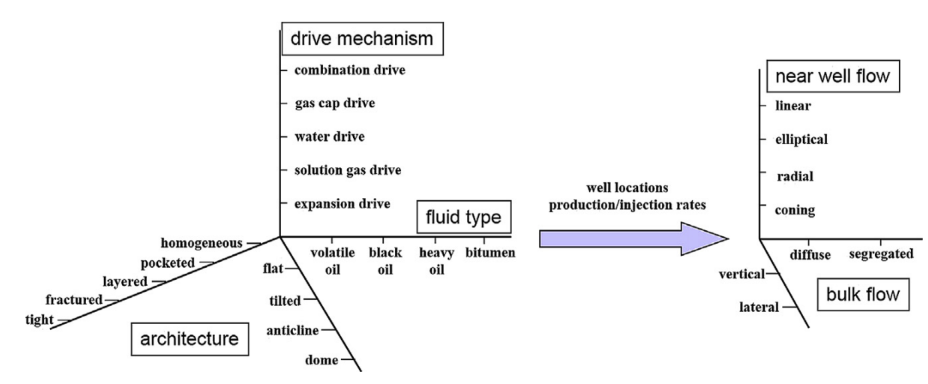
Baker et al [2015] shows an interesting illustration the possible classification of oil reservoirs according to fluid type, drive mechanism, reservoir architecture, and flow patterns.
See Also:
-
Architecture
-
FMB and Rate Transient Analysis (RTA) (Near Well Flow)
References
-
Richard O. Baker, HRichard O. Baker, Harvey W. Yarranton and Jerry L. Jense, “Practical Reservoir Engineering and Characterization“, 2015rry L. Jensen