
In Australia, gas is generally produced from the Walloon Coal Measures. These coal-bearing formations consist of many thin coal seams separated by low-permeability rock. The coal seams collectively make up a small proportion of the total thickness of the coal-bearing formation.
Coal seams of the Walloon Coal Measures are thin and does not continue laterally similar to those in the Bowen Basin [24,99]. Although thickness and gas content in the Surat Basin are lower, the key to success in the Surat Basin has been the higher permeability. Permeability of the Walloon Coal can range from 5 to 5,000 mD.
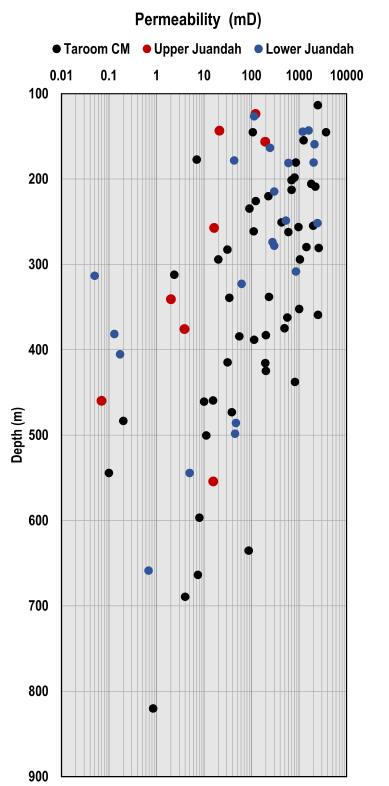
Based on pressure transient analysis, the figure below shows in-situ permeability versus depth for:
-
Taroom Coal Measures
-
Upper and Lower Juandah Coal Measures
Although the general trend shows decline with depth however, there is significant variability in permeability. Mazumder, Jiang [178] performed production history matching on 14 wells in the Surat Basin and reported permeability values in the range of 65–310 mD for the wells completed in the Taroom Coals, 90–275 mD for the wells completed in the Juandah Coals and 75–320 mD for the wells completed commingled across both Taroom and Juandah coals.
References:
-
Mazumder, S.; Jiang, J.; Sharma, V.; Sugiarto, I. Production Data Analysis of CBMWells in Surat Basin. In SPE Unconventional Resources Conference and Exhibition-Asia Pacific; Society of Petroleum Engineers: Brisbane, Australia, 2013.
-
Alireza Salmachi, Mojtaba Rajabi, Carmine Wainman, Steven Mackie, Peter McCabe, Bronwyn Camac and Christopher Clarkson, History, Geology, In Situ Stress Pattern, Gas Content and Permeability of Coal Seam Gas Basins in Australia: A Review, Energies, 2021
-
“Bowen Basin Concept Study”, Final Report, Queensland Government - Department of Resources, 2 December 2021