
Introduction
In basic terms Multi-fractured Horizontal Wells (MFHW) are wells in which multi-hydraulic fractures are produced normal to the horizontal trajectory.
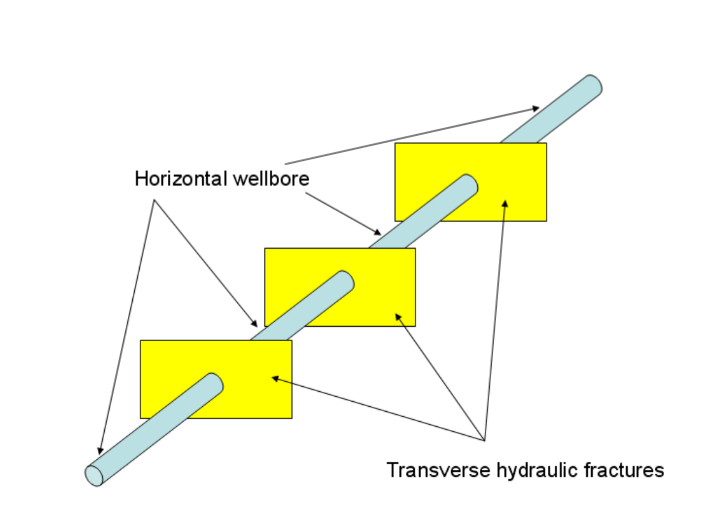
The MFHW model in AFA is adapted from Zhang et. al. 2019. The model assumes a sequence of evenly spaced infinitely conductive transverse fractures.
Idealized Flow Regimes
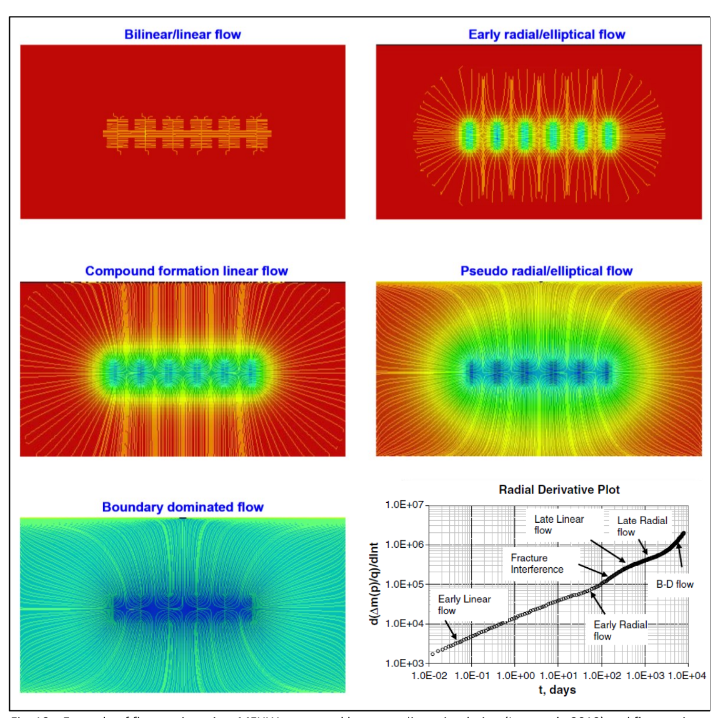
MFHW systems can exhibit many different flow regimes. Depending on the author and source in the (and the assumptions during derivation), there are few different interpretations. In reality, many of these flow regimes are not developed or its duration is insignificant w/r to time.
-
According to Blasingame [2019], the MFHW model is the “Master“ solution for unconventional wells
-
[Industry Wnats A “simple (and direct) RTA approach
-
Distinct Diagnostics (Flow Regimes!)
-
An RTA proxy that will “fit everything“
The figure below shows an illustration a flow sequence based on the work of Ortiz [2013] and Clarkson [2013]. With imperfect data, the “Early Radial Flow“ period is quite likely impossible to observe.
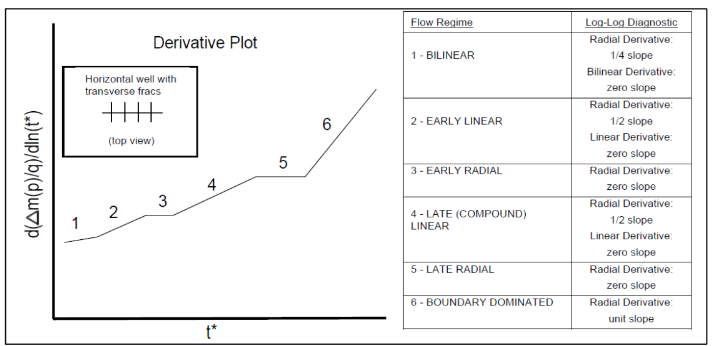
A more idealized version of these flow regimes were presented by Clarkson and Pederson [2010] is shown below. The image assumes the Bourdet (Well Testing) interpretation.
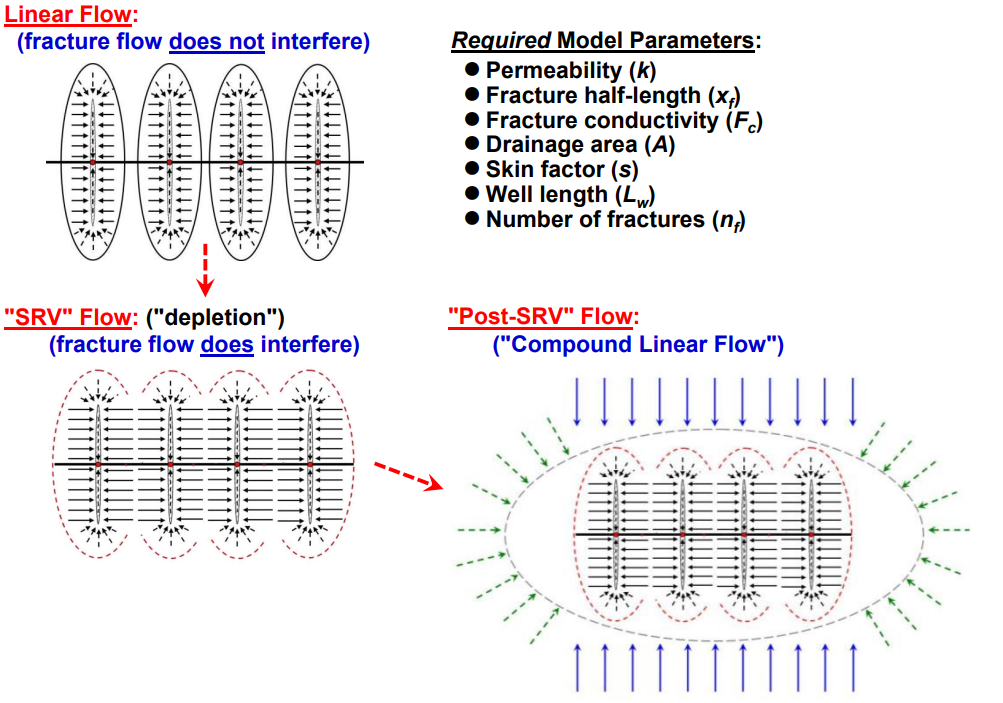
Educational materials from Blasingame [2015] also provides some additional insight into typical flow regimes in Unconventional Reservoir Systems. For more about SRV, refer to Stimulated Rock Volume (SRV) . During Bilinear/Linear flow (or transient linear flow), the fracture contribution is additive when there is no interference.
In 2011, Song and Economides presented the following figure. The upper image shows their typical flow regimes in a MFHW. The lower figure is the corresponding Bourdet (Well Testing) derivative. Predico does consider the terminology a bit “over-the-top“.
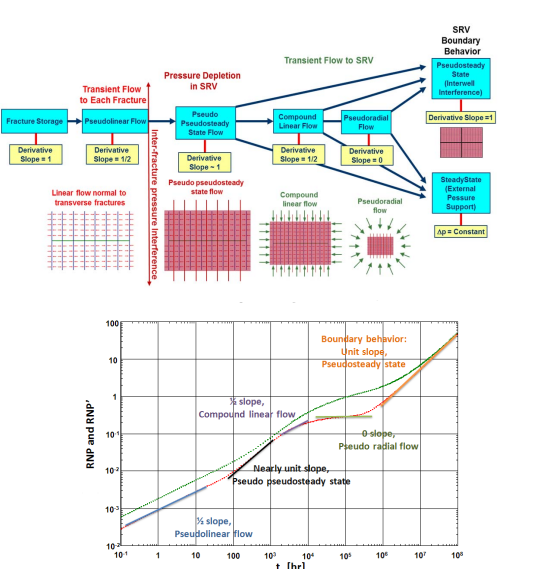
If we review the same data on typical pseudo RTA plots shown below, we can see the flow regimes in a log rate- log time plot [Blasingame, 2019].
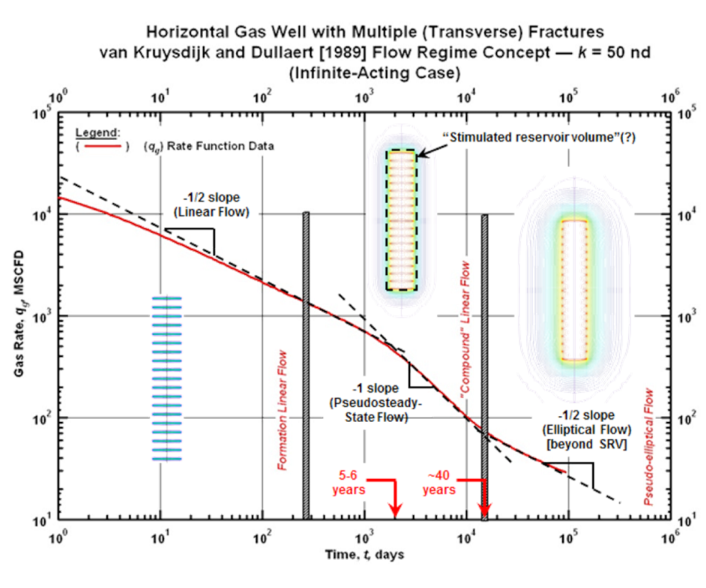
Practical MFHW Flow Regimes
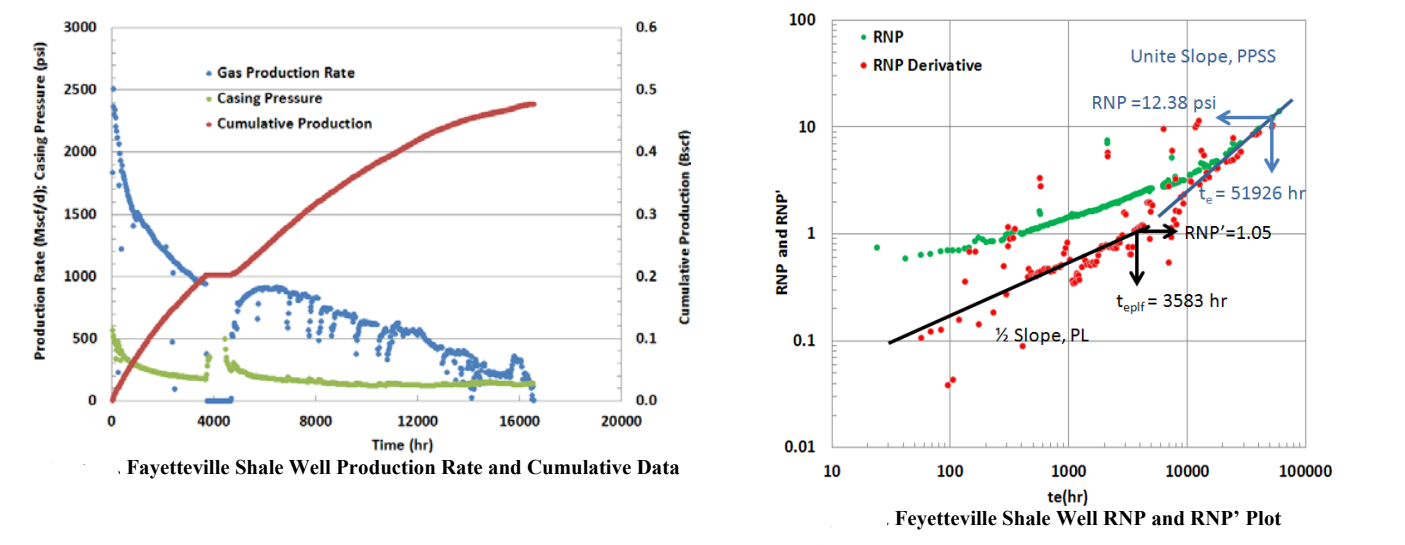
In this example below, Song and Ehlig-Economides, present a field example of a Shale Gas Well. Looking at the traditional Bourdet (Well Testing) derivative on the right, we see pure linear flow (1/2 slope) and then PSS.
This field data looks like a good candidate for the AFA Linear Flow Models as none of the other flow regimes (bilinear, radial etc) are actually observed. The Multi-Fractured Horizontal Well is reserved for cases with far more detailed data.
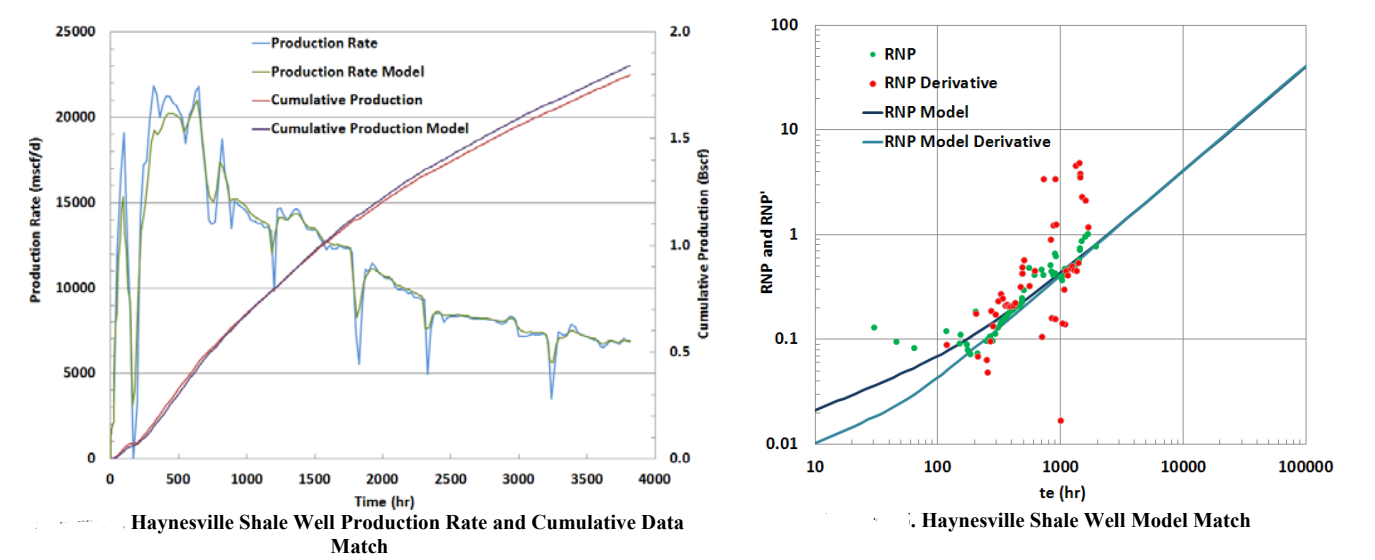
Below is another example presented by the authors showing a history match.
If the analyst is solely interested in using the linear analysis model, Predico AFA developed and automated Linear Flow Models with its Stimulated Rock Volume (SRV)model.
In 2008, Ilk et al, demonstrated conclusively that useful well-reservoir models can be inferred from such data (they also indicated that a history match must also be completed as part of the QC).
Deviations from Linear Flow
Although the previous examples have diagnosed PSS as the deviation from linear flow, other possible causes include:
-
Analyzing single phase in a multiphase system due to the dynamic effect of changing saturations and relative permeabilities leading to apparent boundary dominated behavoir.
-
Offset well interference
-
Missing production history
Linear & Compound Linear Flow Calcs
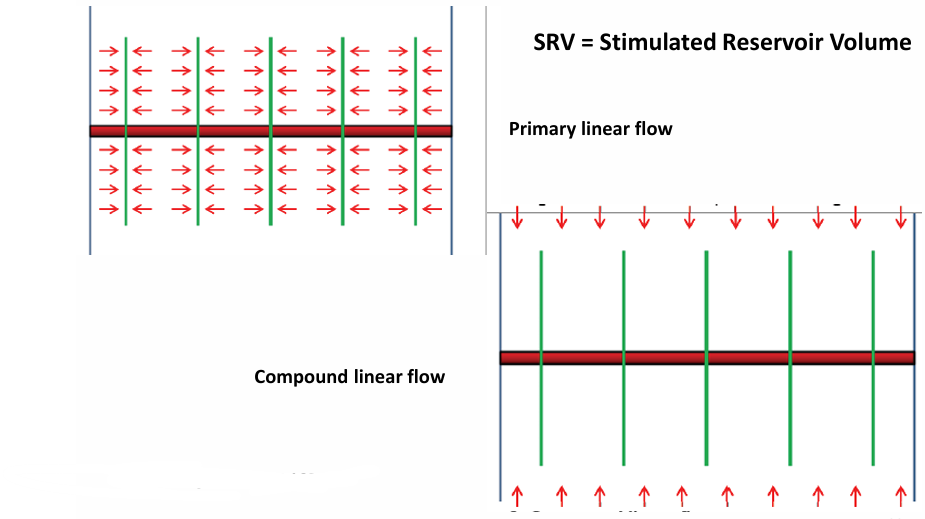
Seidle [2017] described linear flow in two scenarios shown below. Refer to Stimulated Rock Volume (SRV) and/or Linear Flow Models for more detial.
References
-
John Seidle, “Adaptation of SPEE Monograph 4 to Wyoming Horizontal Plays“, October 12, 2017.
-
Juan Manuel Lacayo Ortiz, Pressure Normalization of Production Rates Improves Forecasting Results, M. Sc. Texas A&M University 2013.
-
Clarkson, C.R. 2013. Production Data Analysis of Unconventional Gas Wells: Review of Theory and Best Practices. International Journal of Coal Geology 109–110 (0): 101-146.
-
Clarkson, C.R. and Pedersen, P.K. 2010. Tight Oil Production Analysis: Adaptation of Existing Rate-Transient Analysis Techniques. Paper presented at the Canadian Unconventional Resources and International Petroleum Conference, Calgary, Alberta, Canada. Society of Petroleum Engineers SPE-137352-MS.
-
Bo Song, Pressure Transient Analysis & Production Analysis for New Albany Shale Gas Wells, M. Sc Texas A&M, 2010.
-
Bo Song, Christine Ehlig-Economides, Rate-Normalized Pressure Analysis for Determination of Shale Gas Well, SPE 144031.
-
T. A. Blasingame, Reservoir Engineering Aspects of Unconventional Reservoirs, SPEE Lunch Presentation, 08 July 2015.
-
D. IIk, A.D. Perego, J. A. Rushing, and T.A. Blasingame, Integrating Multiple Production Analysis Techniques To Assess Tight Gas Sand Reserves: Defining a New Paradigm for Industry Best Practices, SPE 114947
-
T. A. Blasingame, Reservoir Engineering Aspects & Forecasting of Well Performance in Unconventional Reservoirs, SPEE Presentation, 02 May 2019, Brookhaven College.
-
Darryl Tompkins, Common Causes of Deviations from Linearity on Linear Flow Plots, SPE Workshop: New Perspectives in Well Performance Analysis and Production Forecasting, 28-30 April 2025, Colorado Springs, Colorado.
-
Zhang, L., Chen, Z. and Zhao, Y.L., 2019. Well production performance analysis for shale gas reservoirs (Vol. 66). Elsevier.