
Introduction
Petrophysical parameters are used in the field of geology and petroleum engineering as they help characterize and evaluate subsurface rock formations. Here is a summary of some basic petrophysical parameters:
-
Porosity: Porosity measures the percentage of void space (pores) within a rock or sediment. It indicates the potential for fluid storage within a reservoir. Porosity can be calculated as the ratio of pore volume to total rock volume. For porosity with respect to coals, refer to Cleat Porosity, and for general unconventional reservoirs refer to Shale Porosity .
-
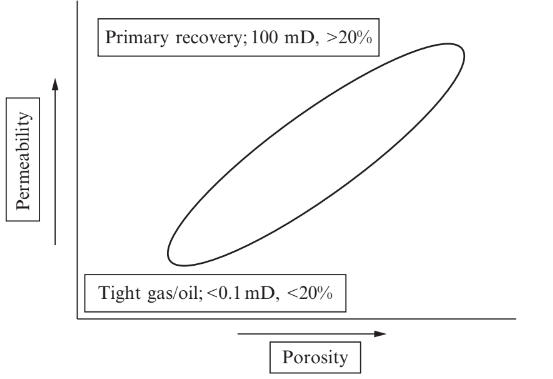
Permeability: Permeability represents a rock's ability to transmit fluids (e.g., oil, gas, water). This is used to determine the flow rate of hydrocarbons through a reservoir. Porosity and permeability are related properties of any rock or loose sediment. Although a relationship between porosity and permeability is often difficult to interpret, there are trends that show a very general relationship between the two properties as illustrated below:
-
Saturations: The amount of gas and/or liquid within the pores.
-
Compressibility (Isothermal): The Isothermal Compressibility of a fluid or substance is defined as the relative change in volume (dV/V) per unit change in pressure (P).
-
Net Pay: Often defined as the thickness of the formation that contributes to the flow of fluids.