
Introduction
The different types of unconventional gas, and the naming conventions, generally depends on their geological origin. Broadly speaking, there are three (3) main types as discussed below.
According to the general petroleum engineering literature,:
-
Shale gas is formed in sedimentary rock of very fine-grained, or small particles, such as clay. Also organic rich (usually < 50%, while coal is by definition > 50% organic matter)
-
Tight gas refers to gas found in very low permeability reservoir rocks that are often sandstone, but also include low permeability carbonate rocks.
-
Coal Seam Gas (CSG) (or Coal Bed Methane) is found in coal seams.
Discussion on Low Permeability Systems
Low permeability, which according to Blasingame [2008, 2023], is caused by:
-
Depositional issues: very small grains mixed with detrital muds (clays)
-
Diagenetic issues: clay precipitation, significant cementation, pressure compactions, etc
-
In general, flow behaviour in low and ultra-low permeability reservoirs yields very poor recovery unless the reservoir is significantly stimulated.
If the tight gas reservoir is naturally fractured, then the gas flow is mainly controlled by the open fractures that are connected to the wellbore.
In terms of EUR estimates, Blasingame [2023] suggests that at least 18-36 months of production is required. Given that many unconventional plays are highly heterogeneous, analogues are not ideal. Reservoir surveillance and performance management is essential.
Characteristics of Shale
Compared to conventional reservoirs, shale is:
-
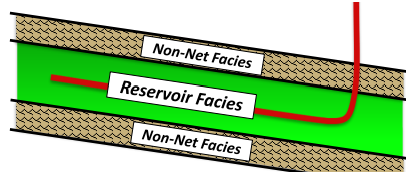
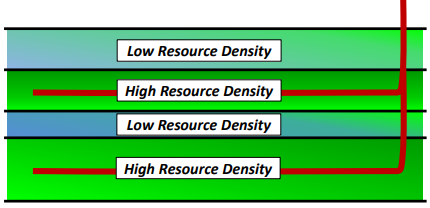
“Continuous-type” deposit. Unconventional resources do not typically conform to trap configurations nor are the distinct/connected phase boundaries apparent.
|
Type |
Continuous Isolated Flow Unit |
Continous Stacked Reservoir Unit |
|---|---|---|
|
|
|
|
|
|
-
Self-sourced hydrocarbons (see Isotherm ) from Organic Matter leading to potentially enormous volumes of hydrocarbon.
-
Potentially lower porosity
-
Geological rock often rich in clay
-
Very low to ultra-low permeabilities (challenging for PTA work)
-
In RTA projects, estimate OGIP/OOIP should be considered as contacted gas, which may increase with time.
-
-
Significant and/or complex extraction effort often requiring complex well design such as Multi-Fractured Horizontal Well along with stimulation.
-
Often higher water saturations
-
Often transient dominated as opposed to boundary dominated flow (relevant to PSS Models)
Clarkson & Ambrose Discussion
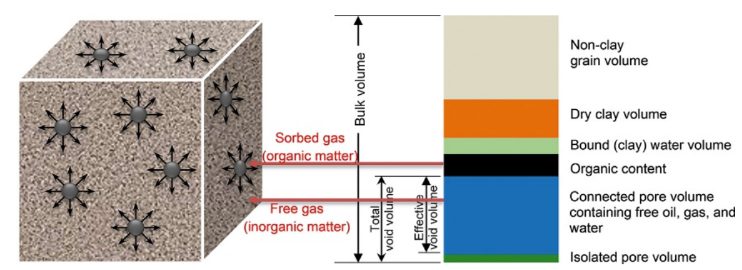
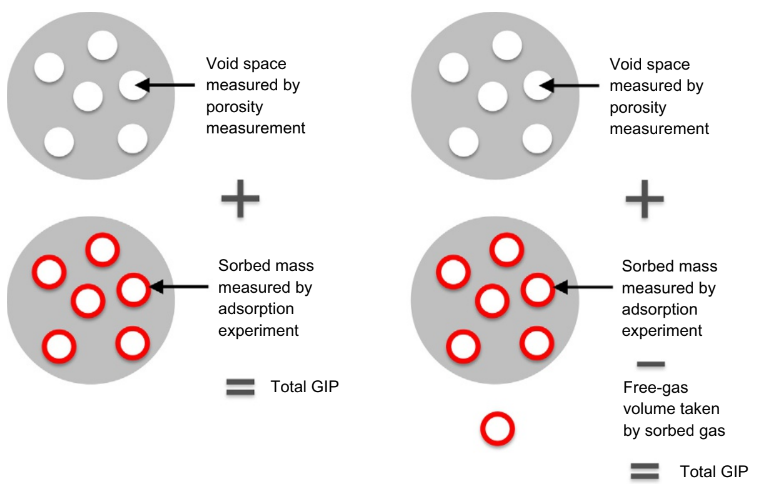
The figure below shows a conceptual model from Clarkson [2021] showing the different constituents of a shale matrix. Traditionally, the connected pore volume has been assumed to contain free-fluid storage, whereas organic matter has been assumed to contain absorbed gas.
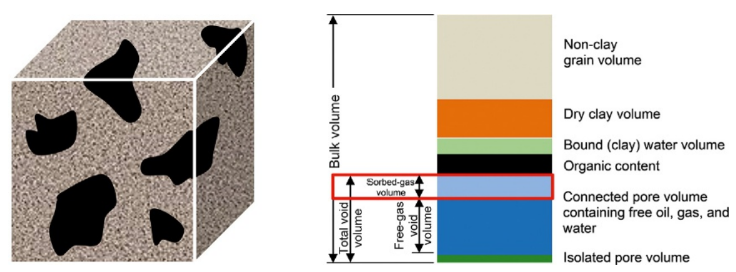
In contrast, Ambrose et al [2012] challenged the historical model and suggested that sorbed gas volume must be corrected/accounted for in the free-gas storage calculations. Essentially, Ambrose suggested that free gas and absorbed gas cannot be calculated independently.
References:
-
T. A. Blasingame, Analysis Well Performance, v20230723, Texas A&M.
-
T. A. Blasingame, The Characteristic Flow Behaviour of Low-Permeability Reservoir Systems, 2008, SPE 1141698
-
J. Allen, Geology of Unconventional's, 2023, Ryder Scott Conference,
-
C. R. Clarkson, Unconventional Rate Transient Analysis (Volume I & II), Copyright © 2021 Elsevier Inc.e
-
Hassan Bahrami, Evaluating Factors Controlling Damage and Productivity in Tight Gas Reservoirs, PhD Thesis, Curtin University, 2012.