
Introduction
With respect to formation damage and flow impairment, there are generally two types of issues related to clay:
-
Formation damage as simply impairment to flow caused by a reduction in the Permeability in the near wellbore region.
-
Clay dispersion which involves fine migrations of clay particles that are transported by downhole fluids.
In both scenarios, the integrity of the pore space is often altered and the Permeability is reduced - making it more difficult to extract hydrocarbons.
Clay Structure
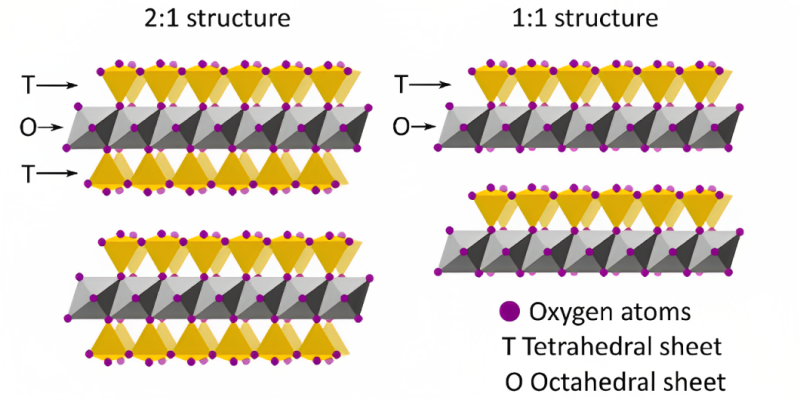
Clay minerals exhibit a unique phyllosilicate structure that consists of sheet-like layers compromising varying configuration of silica tetrahedral and alumina octahedral sheets as shown below:
Clay Distributions
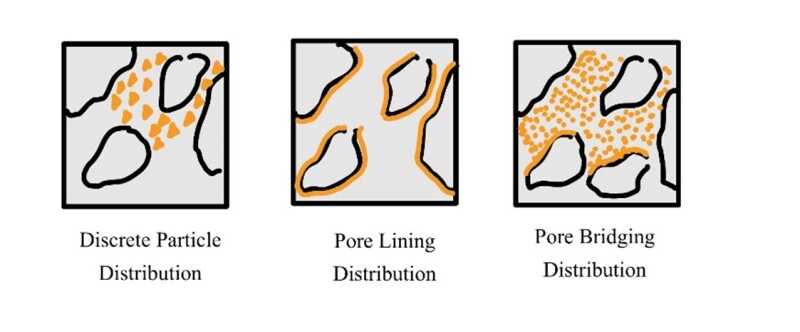
There are many distributions that clay minerals assume within a rock’s pore spaces. The three most common include discrete particle distribution, pore-lining distribution, and pore-plugging distribution as depicted below:
Clay Swelling in CSG
The hydration and swelling of clay-rich strata upon contact with water-based drilling fluids and low salinity formation waters presents challenges in drilling and production activities in many unconventional oil and gas fields, including shale-gas and coal seam gas (CSG) fields. Clay swelling in coals is often considered a Wellbore Skin and Formation Damage effect. For additional images, refer to SEM section of formation damage .
In CSG wells drilled in the Surat Basin of Queensland Australia the problems associated with clays welling are exemplified in open-hole completions across multiple thin coal seams (usually less than 1 meter thickness) as well as clay-rich interburden layers. Some of these layers can be comprised of 60% clay minerals such as kaolinite, smectite, illite and chlorite - where smectites are widely known in the petroleum industry to be the swelling clays when in contact with brackish.
According to Towler et al (2016), The swollen clays spall into the well bore, creating a very fine sludge that must be lifted out with the production water and gas. This sludge is viscous and difficult to pump. If the well is ever shut in the sludge tends to settle in the pump elastomers, causing the pump to seize and become difficult to re-start.
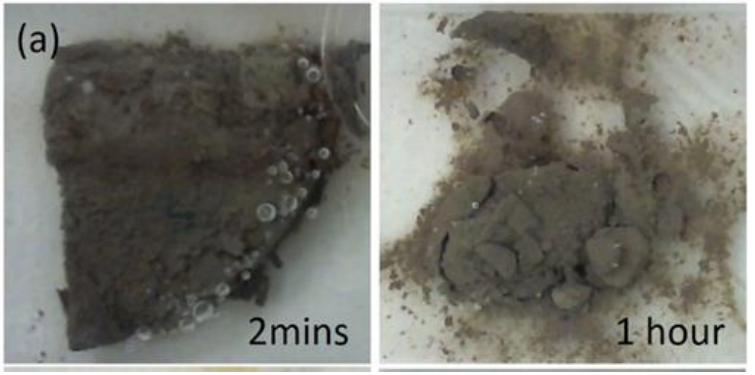
The figure below shows the breakage of particles in coals due to contact with fresh water.
As mentioned above, such produced solids can damage downhole water pumps, which obviously leads to production and maintenance costs.
In the Surat Basin (Queensland, Australia), the main source of fines is understood to be interburden mudrock layers that are rich in smectite clays. The swelling of smectite clays, found in mudrock layers between coal seams, on contact with drilling fluids and the water produced from the coals leads to breakage of particles
In some CSG wells drilled in the Surat Basin, the typical clay stabilisation strategy is to use drilling fluids containing 4 wt% KCl. However, Rufford et al suggests that the control of clay swelling with KCl brine is often only effective for a short time.
Of course, the blocking of pore throats by expansion of clay minerals when using fresh water is also an problem.
See Also:
References
-
Lei Ge et al, A phase inversion polymer coating to prevent swelling and spalling of clay fines in coal seam gas wells, 2018, International Journal of Coal Science Technology.
-
Thomas E. Rufford , Archana Patel , Lei Ge, Brian Towler, and Victor Rudolph, Methods to Control Swelling in Coal Bed Methane Wells, University of Queensland.
-
Towler, Brian / Firouzi, Mahshid / Underschultz, James / Rifkin, Will / Garnett, Andrew / Schultz, Helen / Esterle, Joan / Tyson, Stephen / Witt, Katherine, An overview of the coal seam gas developments in Queensland, 2016, Journal of Natural Gas Science and Engineering
-
Alaskar, S., Clay Stabilizers: A Tug of Water Between Performance and Sustainability, JPT July 18, 2023