
Eagle Ford Study Case
John Lee [2020] presented that well spacing affected fracture geometry in a study of Eagle Ford. Lee concluded that after 400 days of production from the primary producer, the infill well was drilled. However:
-
Model simulation and other work showed that:
-
400 ft well spacing showed asymmetric fracture network development was skewed toward the pressure sink created by the parent-well (there could be fracture interference). The fractures favour depleted areas rather than undrained areas.
-
Of course, at higher well spacing, there was much less of a problem
-
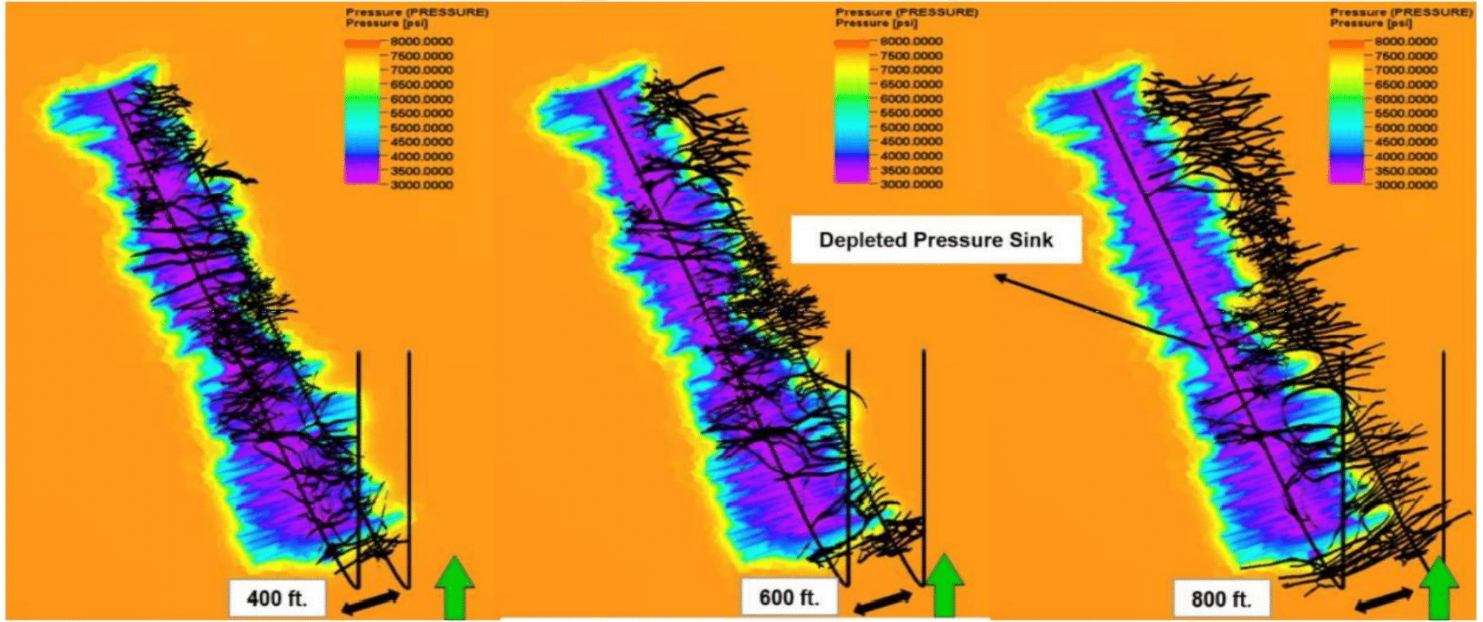
Lee concluded that physics-based forecasting was far more reliable for well spacing optimization. Further in his study, he also concluded that:
-
Methods such as decline could only be used to forecast production accurately for the primary wells - at least up to the time of interference.
-
“Parent, child” well relationships (particularly EURs in infill or closely spaced wells) improperly and optimistically forecasted
-
Science (physics) based forecasting clearly provided more accurate forecasts for infill wells, particularly after interference. It also provides the basis for more accurate forecasts for infill wells. Modelling is a good basis for economic analysis.
Recent Trends in Well Spacing
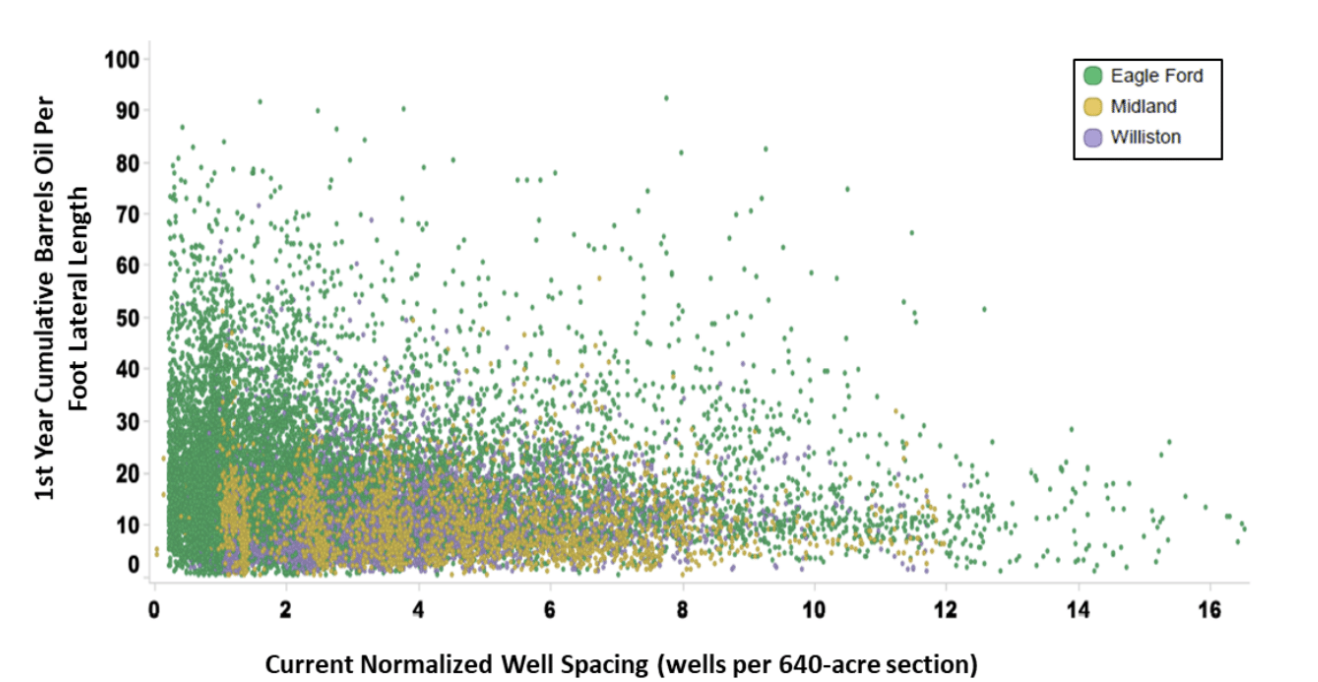
Work by Little [2019] indicated that sensitivity work is required to determine how much interference may be tolerated to capture potential profitable incremental hydrocarbon. Well spacing optimization is a major concern in North American shale and tight gas markets. The graph below shows some sample well spacing observations.
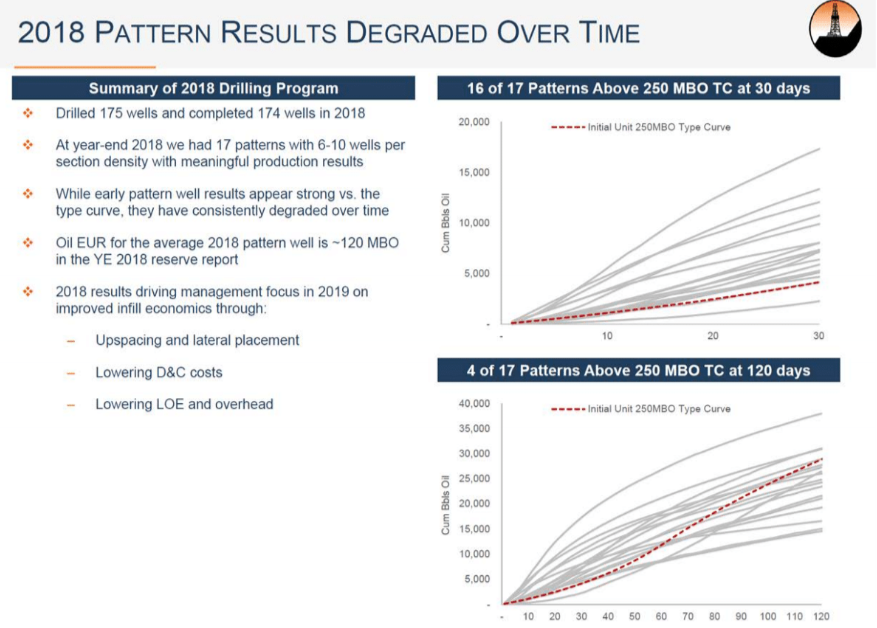
Another interesting observation by Little [2023] was that type curve degradation is a common phenomenon. Relying on information public information ALTA MESA, Little presented the following:
Other issues that can lead to problems with type well generation [Lee, 2019] also include;
-
Survivor bias
-
Small Well Count
-
Exclusion or exclusion of shut-in wells
-
Anomalies
-
Changing Well Design & Recompletions
Work by Corrie-Keileg [2019] and Ilk [2014] also indicated that type wells and similar were very poor for estimating the existence of potentially moveable hydrocarbons, and new discoveries which severely hampered PRMS estimations of contingent resources. Some key take aways were
-
Analytical (or higher) procedures should be used to estimate a Contingent Resource
-
Time-rate-pressure data analyses need to become the dominant tool for evaluating completions and forecasting production.
-
Diagnostic analyses should be performed prior to model-based analyses to identify flow regimes and consistency of data. See also:
In 2018, the Society of Petroleum Evaluation Engineers (SPEE) actually established a committee to review how type curves are generated. According to Gonzenbach [2018, 2019], “type wells are one of the most critical tools used in reserve estimation for both conventional and unconventional plays… [yet] to date, there are no concise or commonly accepted industry guidelines on the subject“. Key take-aways were:
-
Establish Practical Industry Guidance Adherence to Fluid Flow Principles. Similar to Ilk [2023], there is a need to incorporate the fundamentals of flow mechanisms which might include:
-
Near critical fluid behavouir
-
Stimuation etc
-
-
Flow regime identification is also key to establishing parameters for a suitable production forecast. shown in Hyperbolic (Arps) and Flow Regime Identification , flow regimes outside of boundary dominated flow are often power-law relationships and will always tend to overestimate EUR.
-
Scaling (anything from well depth to permeability)
-
Analytical methods based on rigorous production data have no pre-conceived reservoir interpretation.
-
They will unbiasedly identify the reservoir drive mechanism and key reservoir architecture.
-
Analytical methods should be used to constrain simulation (if not machine learning models etc)
-
References:
-
Want to Forecast Well Interference in Resource Plays? Try Using Flow Models, John Lee, 1 September 2020, SPEE Denver Chapter.
-
Well Spacing & Reserves Impacts, Neil H. Little, 1 November 2019, SPEE Houston Chapter
-
Are All Those Bad Things They’re Saying About Our Production Forecasts in Unconventional’s True? John Lee, 24 October 2019 SPEE Denver Chapter
-
The PRMS - An Australian Perspective, Anthony Corrie-Keilig, SPEE Australia, 2019.
-
SPEE Monograph 5 Update on Type Well Profiles, Gary J. Goznebach, 10 October 2018, SPEE Denver Chapter.
-
Rigorous Gas Field Production Data Analysis APPEA 2019, Antony Corrie-Keilig IntPE (Aus) SPEC