
Introduction
Below are images that describe the varying levels of porosity in unconventional resources. Coal porosity is the void space of this naturally fractured organic rock, which has a wide spectrum of pore sizes.
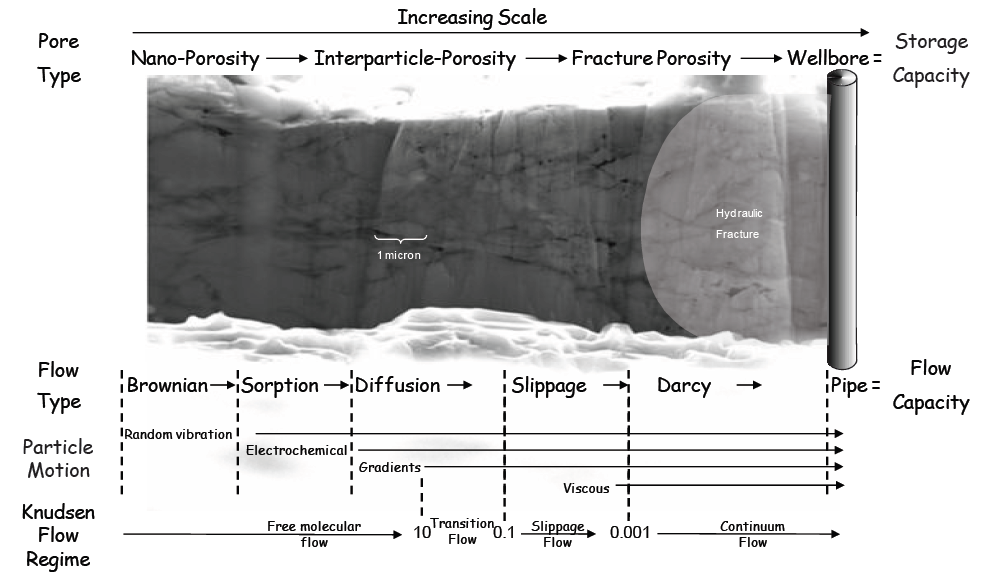
Secondary porosity (Cleat Porosity) is the void space of a coal containing water that will flow through the fractures in response to an applied pressure differential. This is the porosity that is emptied, partially or totally, during “dewatering” and is generally called (Refer to the Porosity section for background on conventional systems).
When pressure in the cleats has dropped to the desorption point, desorption of gas from the matrix into the cleat. Diffusion occurs in response to a concentration gradient at the interface between sorbed gas and free gas.
In summary, the coal matrix contains the primary microporosity, and the cleats provide the secondary macroporosity. Darcy flow of gas in the cleats to the wellbore
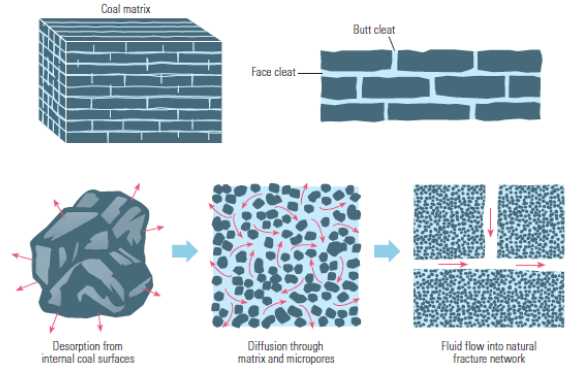
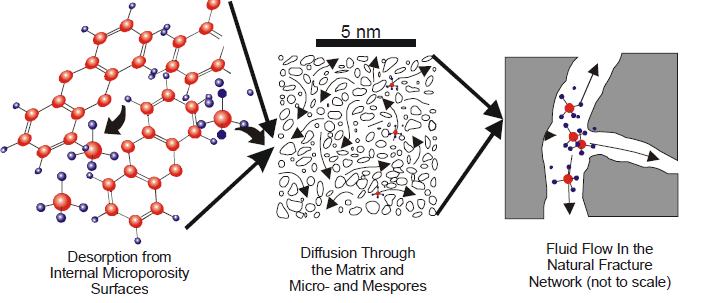
Tased on simulator performance, coal production behaviour is usually controlled by Darcy flow in the cleats, as Diffusion in the matrix tends to be relatively faster than flow of gas in the cleats (Refer to Siedle, 2021 for more details).
References
-
C.H. Sondergeld, K.E. Newsham, J.T. Comisky, M.C. Rice, and C.S. Rai, Petrophysical Considerations in Evaluating and Producing Shale Gas Resources, SPE Unconventional Gas Conference, 23-25 Feb, 2010
-
Bustin, R. M. Geology & Some Engineering Aspects of Coalbed Methane 2001 CBM Solutions,
-
John Seidle, Fundamentals of Coalbed Methane Reservoir Engineering, 2011 PennWell Corporation