
Introduction
The Chow pressure group (CPG) is generally accepted to be a semi-qualitive analysis method.
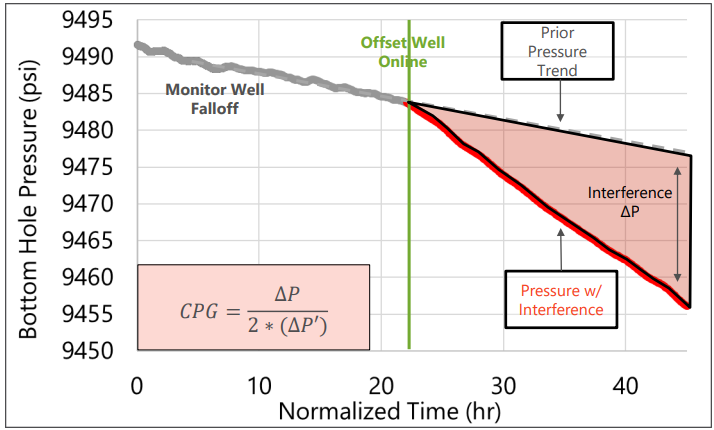
The CPG is defined as:
|
|
Chow Pressure Group |
' aria-hidden='true'%3e %3cg transform='translate(167%2c0)'%3e %3cg transform='translate(-11%2c0)'%3e %3cg transform='translate(0%2c9)'%3e %3cuse xlink:href='%23E1-MJMATHI-43' x='0' y='0'%3e%3c/use%3e %3cuse xlink:href='%23E1-MJMATHI-50' x='760' y='0'%3e%3c/use%3e %3cuse xlink:href='%23E1-MJMATHI-47' x='1512' y='0'%3e%3c/use%3e %3cuse xlink:href='%23E1-MJMAIN-3D' x='2576' y='0'%3e%3c/use%3e %3cg transform='translate(3354%2c0)'%3e %3cg transform='translate(397%2c0)'%3e %3crect stroke='none' width='620' height='60' x='0' y='220'%3e%3c/rect%3e %3cg transform='translate(60%2c819)'%3e %3cg%3e%3c/g%3e %3cuse xlink:href='%23E1-MJMAIN-31' x='0' y='0'%3e%3c/use%3e %3c/g%3e %3cg transform='translate(60%2c-880)'%3e %3cg%3e%3c/g%3e %3cuse xlink:href='%23E1-MJMAIN-32' x='0' y='0'%3e%3c/use%3e %3c/g%3e %3c/g%3e %3c/g%3e %3cg transform='translate(4493%2c0)'%3e %3cg transform='translate(120%2c0)'%3e %3crect stroke='none' width='1309' height='60' x='0' y='220'%3e%3c/rect%3e %3cg transform='translate(60%2c819)'%3e %3cg%3e%3c/g%3e %3cuse xlink:href='%23E1-MJMATHI-70' x='0' y='0'%3e%3c/use%3e %3cuse transform='scale(0.707)' xlink:href='%23E1-MJMATHI-44' x='712' y='-213'%3e%3c/use%3e %3c/g%3e %3cg transform='translate(60%2c-880)'%3e %3cg%3e%3c/g%3e %3cuse xlink:href='%23E1-MJMATHI-70' x='0' y='0'%3e%3c/use%3e %3cuse transform='scale(0.707)' xlink:href='%23E1-MJMAIN-2032' x='712' y='445'%3e%3c/use%3e %3cuse transform='scale(0.707)' xlink:href='%23E1-MJMATHI-44' x='712' y='-452'%3e%3c/use%3e %3c/g%3e %3c/g%3e %3c/g%3e %3c/g%3e %3c/g%3e %3c/g%3e %3c/g%3e %3c/svg%3e)
|
Classic Transient CPG Applications
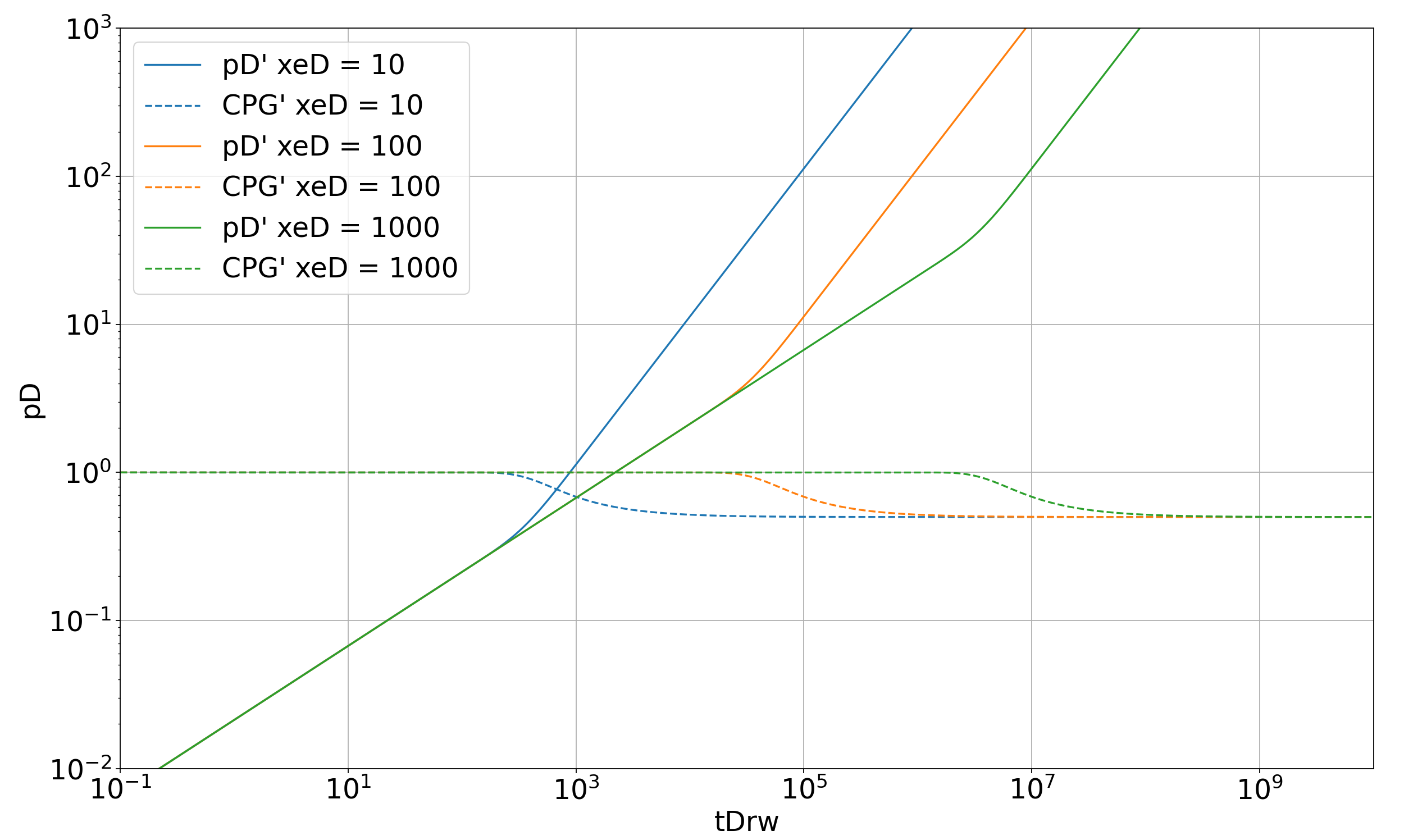
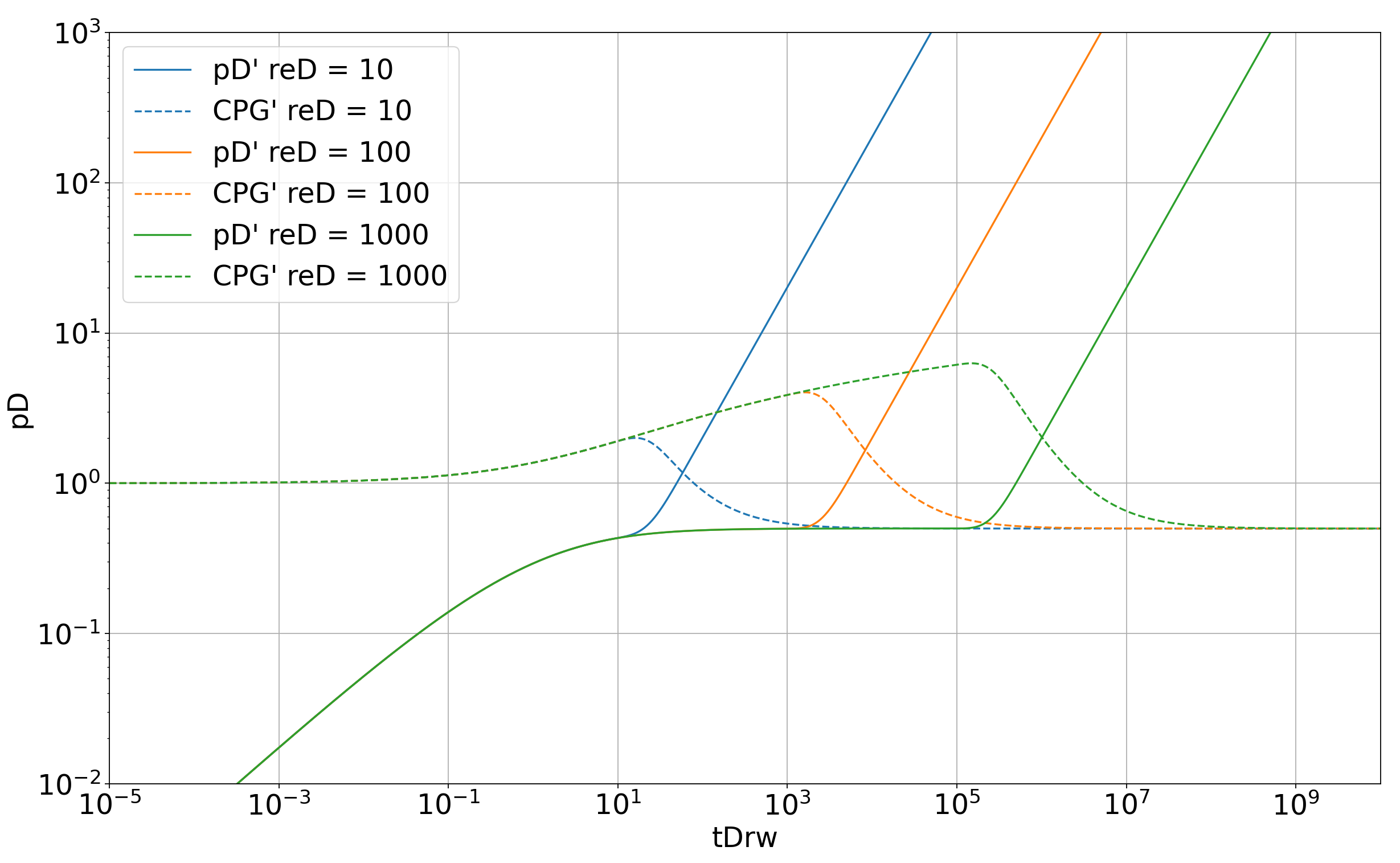
The CPG can commonly be used to identify the following flow regimes in a producing well:
|
CPG value |
Flow Regime |
|---|---|
|
1 |
Linear |
|
1/2 |
Boundary-dominated (no flow boundary) |
Interference CPG Applications:
The Chow pressure group is also commonly used in interference test analysis. Lower values of CPG metric suggest less connectivity between the wells. Basically, lower fracture conductivity results in delayed response at an observation well. The literature suggests that the stabilized CPG metric ranges from 0 to 1+ (based on field observations, particularly the Wolfcamp Shale) for varying levels of interference.
As noted, the magnitude of pressure inference (MPI) is defined as the stabilized CPG value.
|
CPG Value Magnitude of Pressure Interference (MPI) |
Qualitive Level of Interference |
|---|---|
|
0 |
No pressure interference |
|
0 - 0.5 |
Weak to Moderate Interference |
|
0.8 - 1+ |
Strong Interference |
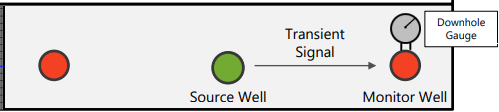
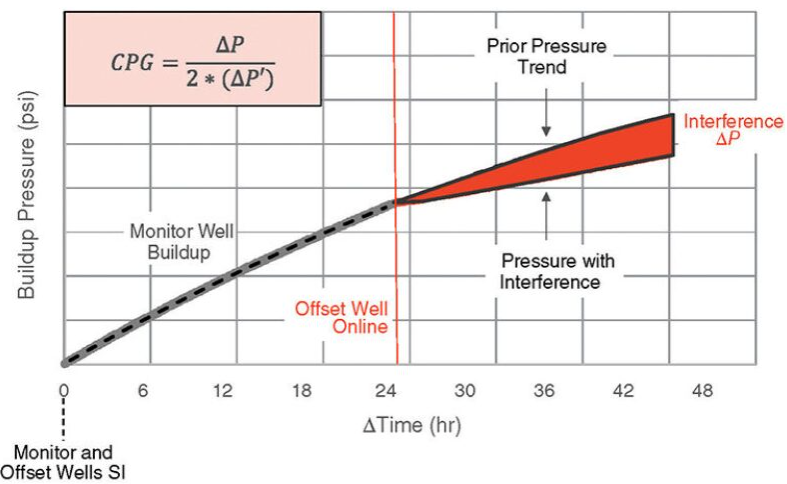
In the example below, the Delta Pressure is the difference between the initial pressure trend at the observation (monitor) well and the trend after the onset of production at the producing (source) well. This is essentially a traditional Pressure Transient Test, and it is therefore recommended to use downhole gauges. In the example below, Ingle [2022] shows a moderate level on interference.
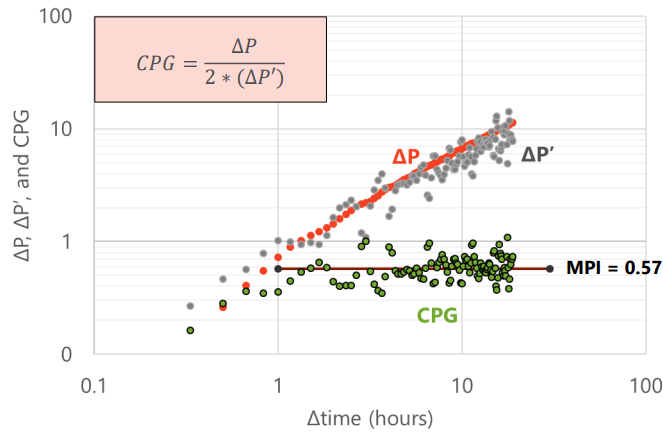
In low and ultra low permeability shale examples, this approach is often used to examine connectivity between Multi-Fractured Horizontal Well via overlapping fractures or similar phenomena (to understand well spacing etc). An interesting observation of the CPG is that it is simply 1/2 of the inverse of the Beta derivative. In the work of Himanshu Shekhar Jha and John Lee [2022] they suggest that the Beta derivative is a better plotting function as it is less susceptiable to noise and the impact of Wellbore Skin and Formation Damage .
CPG for Production and Observation Wells:
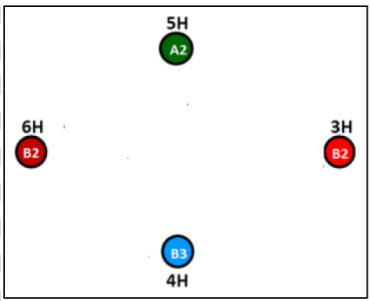
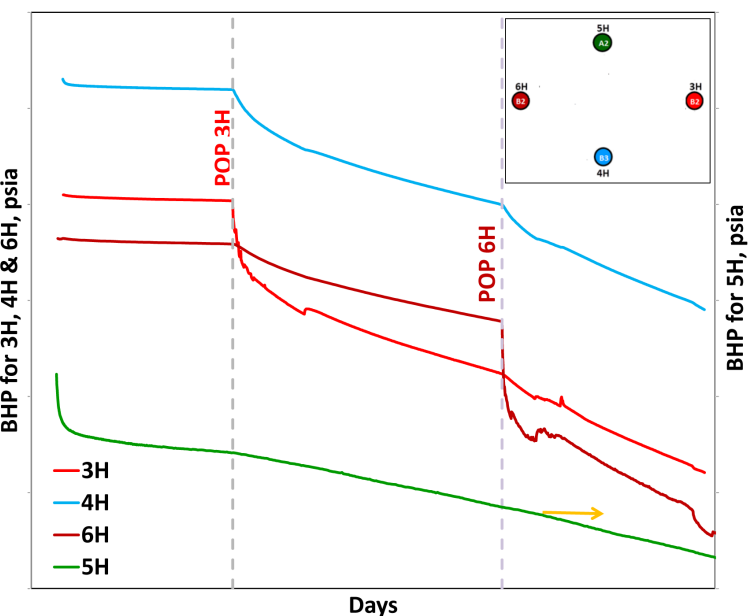
In this simulated example below by Chen et al [2018], 4 horizontal wells are placed in a symmetrical pattern. Well 3H is placed on production (POP) and the pressure observation at the remaining wells. A “gun barrel” view of the 4 wells are shown below, as well as there status at the time of 3H POP.
In this particular example, the results of the CPG analysis would help directionally indicate future well spacing.
|
Well |
Layer |
Status |
|
|---|---|---|---|
|
Well 3H |
Middle Layer |
POP |
|
|
Well 4H |
Deep Layer |
Shut-in |
|
|
Well 5H |
Shallow Layer |
Shut-in |
|
|
Well 6H |
Middle Layer |
Producing |
|
|
|
|---|---|
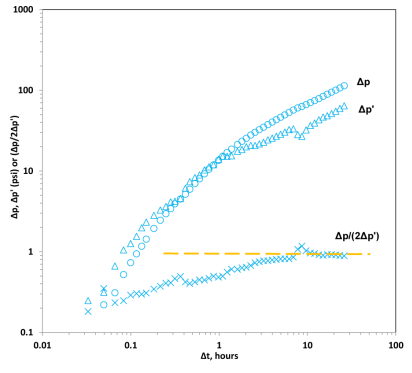
|
Pressure interference at 4H from 3H Strong connectivity with 3H |
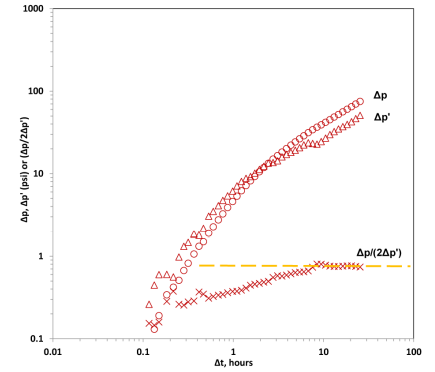
|
Pressure Interference at 6H from 3H Moderate connectivity with 3H
|
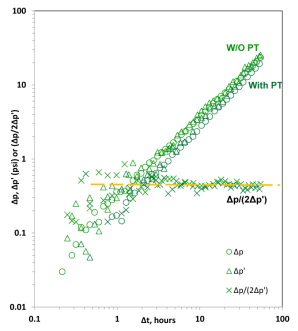
|
Pressure Interference at 5H from 3H Lower connectivity with 3H |
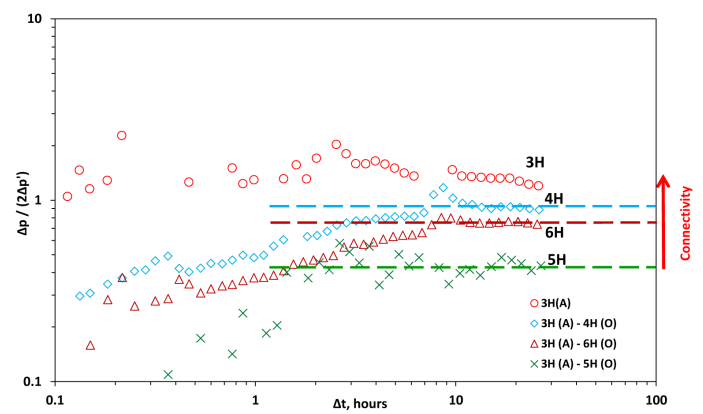
|
The CPG value of the four wells on the same log-log plot, including the POP 3H well. For the 3H Well, the CPG is approx. 1.0 which suggests pure linear flow? |
References:
-
Jacobs, Trent. "The Chow Pressure Group: Shut-In Wells Offer Case for a New Approach to Interference Testing." JPT 2022.
-
Chu, Weichun , Scott, Kyle , Flumerfelt, Ray , and Chih-Cheng Chen. "A New Technique for Quantifying Pressure Interference in Fractured Horizontal Shale Wells." Paper presented at the SPE Annual Technical Conference and Exhibition, Dallas, Texas, USA, September 2018.
-
Ponners, Christoper “Interference Testing in Shale: A Generalized 'Degree of Production Interference (DPI) and Developing New Insights into the Chow Pressure Group”, SPE Workshop: New Perspective in Well Performance Analysis and Production Forecasting, 28-30 April 2025, Colorado Springs.
-
Trevor Ingle, Interference Testing to Optimize Development, SGA Wisdom in Energy Conference, May 15, 2022.
-
Himanshu Shekhar Jha, W. John Lee, Does the Chow Pressure Group Analysis Provide any New Information in the RTA of Unconventional Reservoirs? SPE 210481-MS, 2022 SPE Annual Technical Conference and Exhibition held in Houston, Texas, USA, 3 - 5 October 2022.
-
Weichun Chu, Kyle Scott, Ray Flumerfelt and Chih-Cheng Chen, A New Technique for Quantifying Pressure Interference in Fractured Horizontal Shale Wells. 2018 SPE Annual Technical Conference and Exhibition held in Dallas