
Introduction
It is known that well interference has a negative effect on gas production for conventional gas reservoir. If wells are drilled “too-close”, competitive drainage may occur.
However, with CSG, the effect of interference for adjacent wells is acceleration of de-watering which
should lead to earlier and higher gas rate peaks. If enough wells are not drilled, we may not be able to dewater the reservoir sufficiently to get economic gas rates.
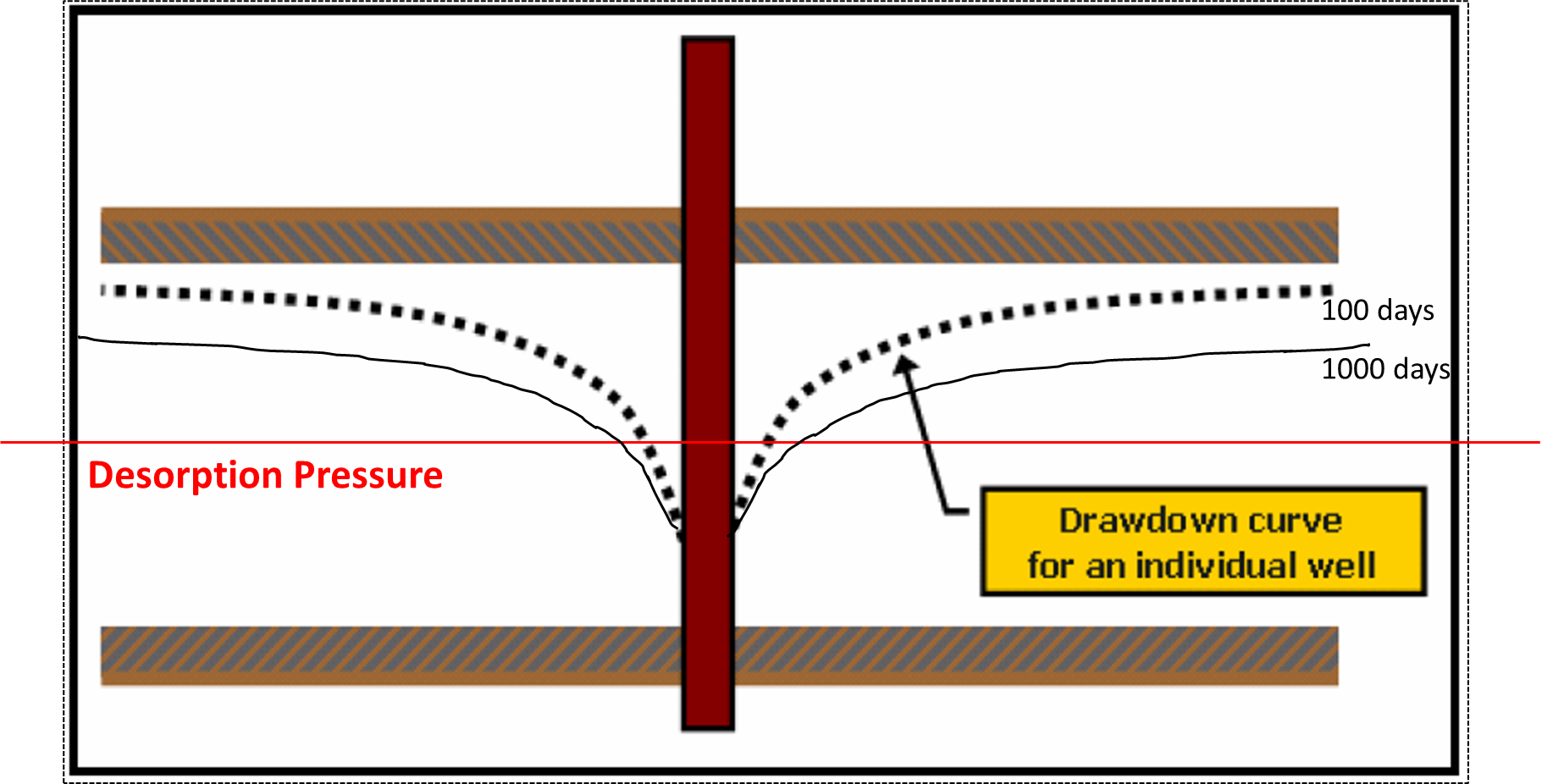
According to the Langmuir Theory, the gas desorbs from coal surface if reservoir pressure reaches the desorption pressure. We need to lower the pressure in order to let the methane desorb from the surface of the coal. CBM wells generally require dewatering to reach this lower pressure.
The first idealized image shows that even after 1,000 days, the cross-section pressure profile of the reservoir is only marginally below the desorption pressure. This suggests that only a bit of gas from the near-wellbore region might produce. If there is adjacent water sources (laterally, or even vertically), it may be nearly impossible to dewater.
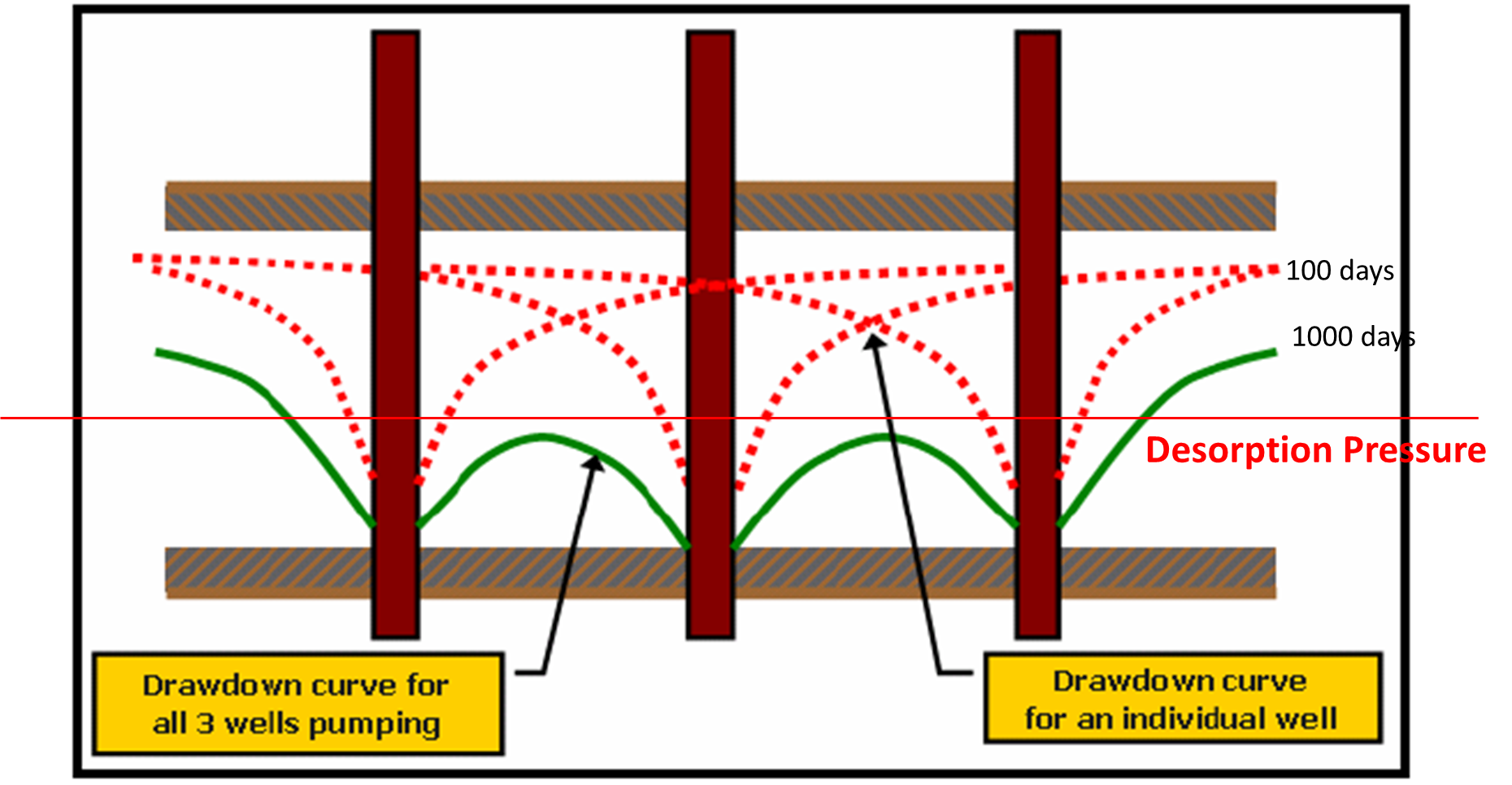
In the example below, three wells are producing, but only the inner well area is truly below the desorption pressure, and therefore most gas production will only occur within the area between the three wells. And there is not enough gas desrobing, it may not even reach a critical point to produce gas as per Relative Permeability As a result, numerous well may be to drilled before any signficant gas production occurs.
In the Powder River Basin, coals are major sources of water and dewatering can be 100’s to 1000 bbl/d to produce gas from individual wells (Bustin, 2001).
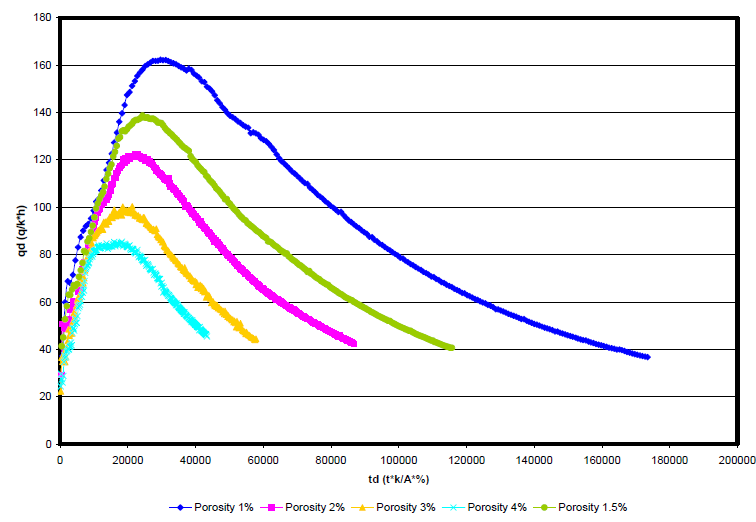
As a result, the size of coal cleats has a significant impact on the ability to produce gas. As shown below, in dimensionless terms, the lower the effect cleat porosity, the better the gas production. If the physical pores are smaller, they hold less water allowing for quicker saturation of gas in the pores, and potenially higher gas rates due to less relative permeability effects.
See Also:
See CSG Well Spacing & Completion Examples
References:
-
Zulkarnain, Ismail, Simulation study of the effect of well spacing, effect of permeability anisotropy, and effect of Palmer and Mansoori model on coalbed methane production, 2006
Texas A&M University -
Arenas, Anangela Garcia, Development of gas production type curves for coalbed methane reservoirs, 2004, West Virginia University
-
Bustin, R. M., Geology & Some Engineering Aspects of Coalbed Methane, 2001 CBM Solutions,