
Introduction
Relatively large gas cap with little or no water drive. Gas cap expansion drives oil.
Frontal drive displacing mechanism, which is desirable. However, gas as a displacing fluid is limited in its efficiency by two (2) main factors
-
Unfavourable viscosity ratios promote fingering of the gas with consequent early breakthrough
-
Gas is normally the non-wetting phase and will preferentially pass through the larger pore spaces, leaving oil trapped in the smaller pore spaces
Typically, in gas-cap drive reservoir, pressure is exerted on the oil by the overlying gas cap, forcing it toward the wellbore.
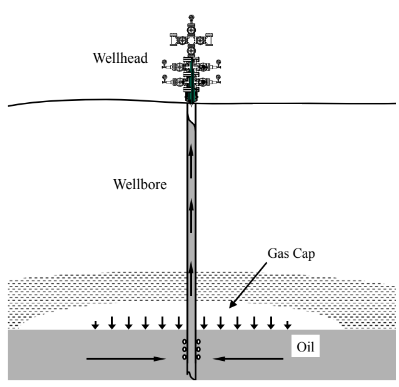
Characteristics
-
Less rapid pressure decline when compared to Depletion Drive Reservoirs
-
Water free production
-
Rapidly increasing GRO in structurally high wells as the gas cap extends into the oil zone
-
Ultimate recovery is better than Depletion Drive Reservoirs but dependent on viscosity and vertical permeability
References:
-
T. A. Blasingame, PETE 663: Introduction to Reservoir Engineering, Texas A&M Course Notes, 2014
-
PETE 2320: Reservoir Engineering, Northern Alberta Institute of Technology (NAIT) Course Notes, 2019.
-
B. Guo et all, Well Productivity Handbook: Vertical, Fractured, Horizontal, Multilateral, and Intelligent Wells, 2008