
Gases subject to retrograde condensation show pressure and temperature conditions greater than the critical temperature and lower than the cricondentherm (temperature is used to identify a gas condensate system). As its temperature is greater than the critical temperature, its original state is gaseous, the lighter hydrocarbons being able to solubilize heavier ones, which would be liquid if were alone at these conditions.
As one lowers the pressure, the solvency power of these lighter hydrocarbons decreases. When one reaches saturation pressure, the heavies come out of solution forming a liquid phase of density as greater than the remaining gas phase as we are far from the critical point. This phenomenon, apparently unexpected, of condensation by pressure reductions is known as “retrograde condensation.”
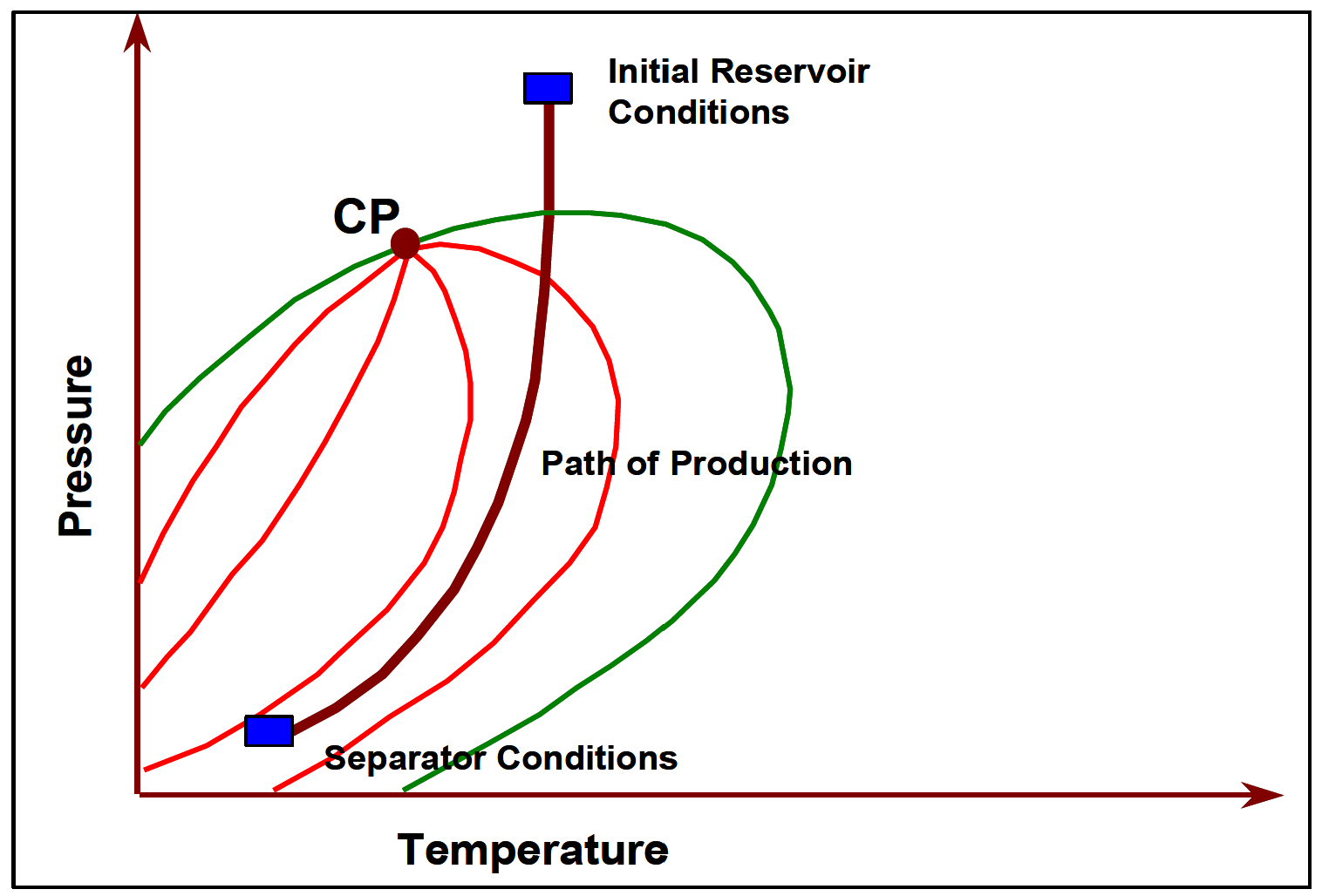
Some basic properties of Gas Condensate reservoirs are:
-
70,000 < GOR < 100,000 SCF/STB
-
Density greater than 60° API
-
Light in color
-
C7+ composition < 12.5%
Reference:
-
M. Barrufet, Texas A&M PETE 310 Reservoir Fluids Course Notes: Three & Multicomponent Mixtures, 2019.
-
T. A. Blasingame, Texas A&M PETE 613 Natural Gas Engineering Course Notes, 2106