
Introduction
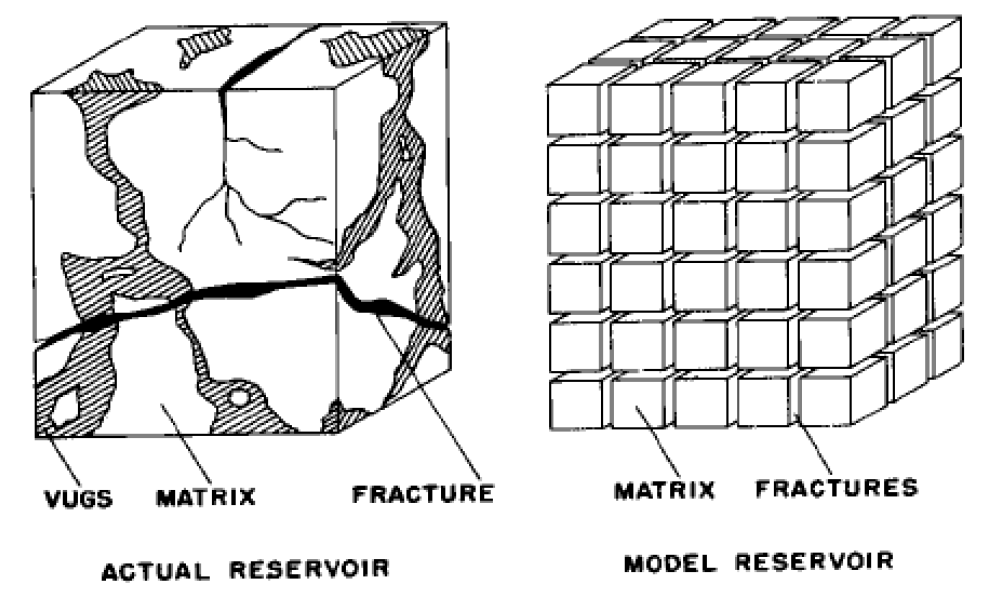
The purpose of the Dual Porosity Model was originally to simplify the naturally fracture reservoirs. It is also can be used to model a reservoir with two different storage systems. Warren and Root (1963) showed that non-homogeneous reservoirs shown can be represented by two dimensionless parameters; lambda (λ) and omega (ω).
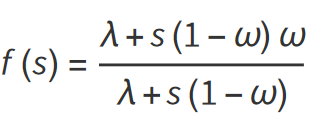
λ, the inter-porosity parameter, is related to the scale of heterogeneity that presents in the system and ω, the storativity parameter, is the measure of flow storativity of the secondary porosity system.
In a dual porosity reservoir, the matrix will normally hold the primary porosity of the system and will not contribute to the flow capacity. On the other hand, the fracture system (hydraulic fracture) will not contribute much to the storage and will be treated as a secondary porosity system. Nevertheless, it will dominate the flow capacity of the system and will be the only medium to transmit the fluid.
The function for the Warren and Root PSS model is given below:
The function for transient dual porosity (slabs) is:

The function for transient dual porosity (cubes) is:

Dual Porosity
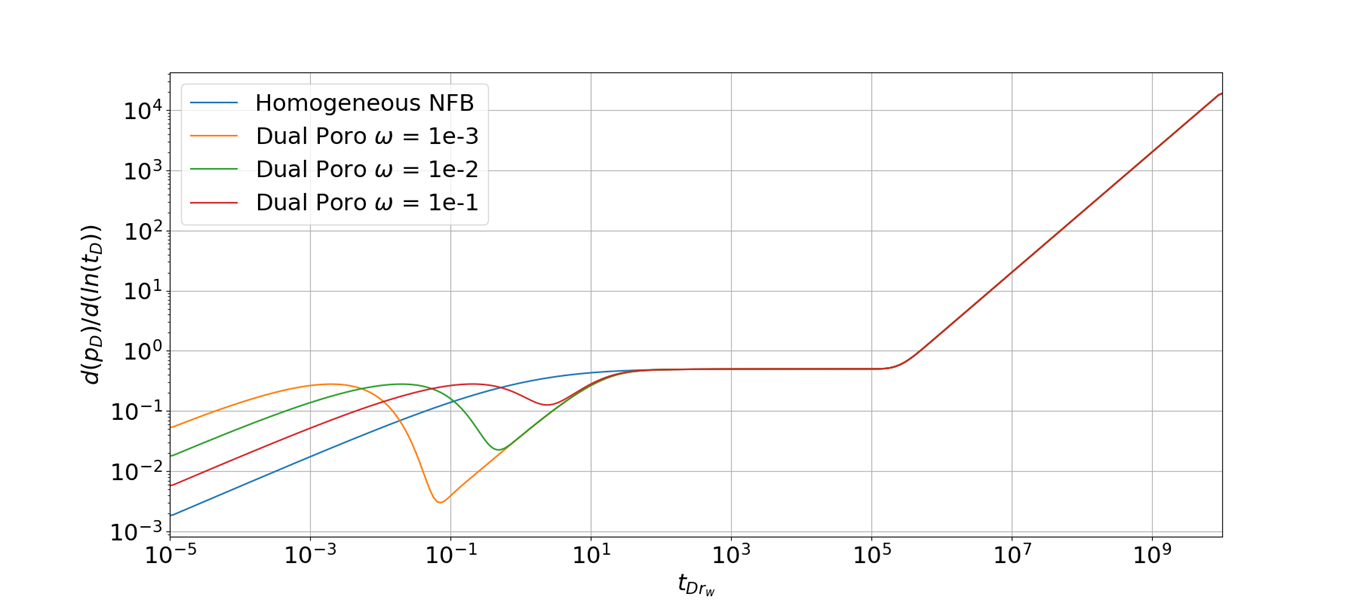
Vuggy Porosity
Dual porosity models may be used simulate dual porosity
See Also:
Core Photos for examples of conventional and unconventional porosity, vuggy porosity, and more.
Computational Considerations
Dual porosity models are applied in Laplace space to a reservoir flow model which is also in Laplace space. The s parameter represents the Laplace transform of time.
References
-
Samandarli, Orkhan, “A New Method for History Matching and Forecasting Shale Gas/Oil Production Performance with Dual and Triple Porosity Models”, M. Sc Thesis, University of Texas, 2011.
-
Wayne Narr, David S. Schechter, Laird B. Thompson, Naturally Fractured Reservoir Characterization
2006, Society of Petroleum Engineers
-
John Lee, John B. Rollins, John P. Spivey, Pressure Transient Testing, 2003, Society of Petroleum Engineers