
Introduction
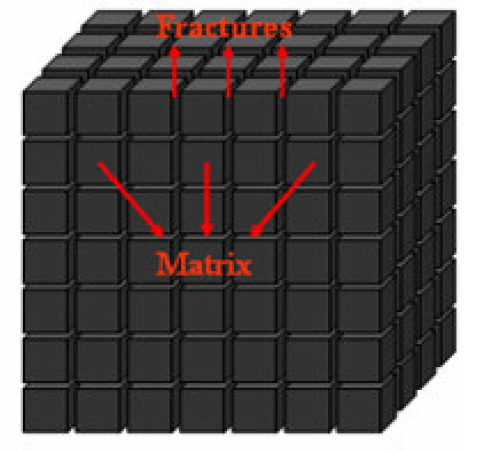
Permeability anisotropy is an inherent property of coal bed methane. Coal bed methane reservoir is considered as naturally fractured reservoir. Coal beds are characterized as a dual porosity reservoir, fractures (cleats) and matrix.
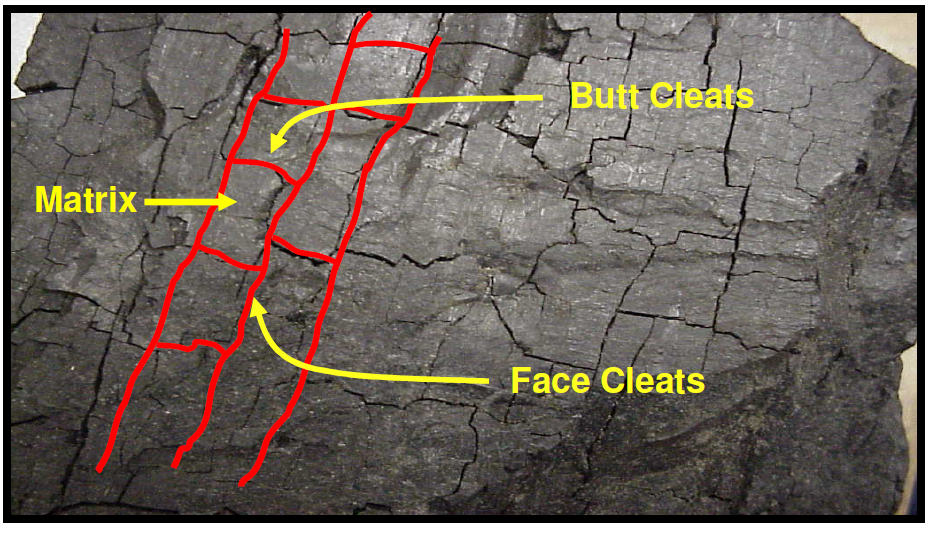
The fractures (cleats) system is consisted of two major fractures system, the face cleats and butt cleats.
The face cleats are long and continuous fractures throughout the coal seams and butt cleats are short and discontinuous fractures perpendicular to the face cleat (refer to image below)
The butt cleats are discontinuous because they are usually intersected by the face cleats. The face cleats has larger contact area with the matrix compare to the butt cleats, therefore it is capableto drain larger area ofcoal seams and assumed as the maximum permeability direction. In some cases, this assumption may not be applicable (such as the Bowen Basin, Australia).
Study of well interference from the Black Warrior Basin indicates that permeability in face cleat direction is much greater than in butt cleat direction. USBM tests with horizontal holes in Pennsylvanian coals showed 2 10 times greater gas production rates parallel to face cleat. According to Bustin (2001), Vertically permeability in coals is generally significantly less than horizontal permeability due the presence of bedding and absence of through going fractures/cleat.
Cleating
Cleats occur on all scales from millimetres to 10’s of centimetres (and may be a fractal property according to Bustin, 2001). The cleats are the fractures that divide the matrix into blocks and contains the macro pores of the system.
In simple Dual Porosity terminology, the micro-porosity of the matrix and macro-porosity of the cleats for the two main porosities. The terms “pore volume”, “macro-pore volume”, and “cleat volume” are all used to represent the same macro-porosity system of the coal.
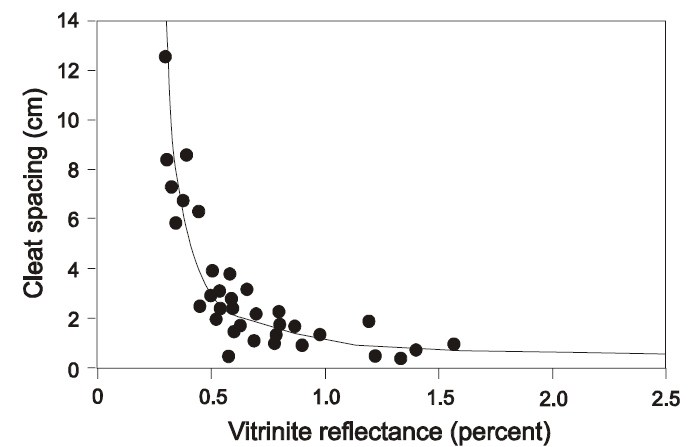
Generally, cleat spacing decreases with rank as shown below.
Permeability Ratio
Clarkson [2021] states that permeability ratios have been observed typically between 2:1 and 4:1 but notes that anisotropy as high as 17:1 have been reported.
' aria-hidden='true'%3e %3cg transform='translate(167%2c0)'%3e %3cg transform='translate(-11%2c0)'%3e %3cg transform='translate(0%2c65)'%3e %3cuse xlink:href='%23E1-MJMATHI-49' x='0' y='0'%3e%3c/use%3e %3cg transform='translate(440%2c-150)'%3e %3cuse transform='scale(0.707)' xlink:href='%23E1-MJMAIN-61'%3e%3c/use%3e %3cuse transform='scale(0.707)' xlink:href='%23E1-MJMAIN-6E' x='500' y='0'%3e%3c/use%3e %3cuse transform='scale(0.707)' xlink:href='%23E1-MJMAIN-69' x='1057' y='0'%3e%3c/use%3e %3c/g%3e %3cuse xlink:href='%23E1-MJMAIN-3D' x='1762' y='0'%3e%3c/use%3e %3cg transform='translate(2541%2c0)'%3e %3cg transform='translate(397%2c0)'%3e %3crect stroke='none' width='1146' height='60' x='0' y='220'%3e%3c/rect%3e %3cg transform='translate(60%2c677)'%3e %3cuse xlink:href='%23E1-MJMATHI-6B' x='0' y='0'%3e%3c/use%3e %3cuse transform='scale(0.707)' xlink:href='%23E1-MJMATHI-78' x='737' y='-213'%3e%3c/use%3e %3c/g%3e %3cg transform='translate(86%2c-715)'%3e %3cuse xlink:href='%23E1-MJMATHI-6B' x='0' y='0'%3e%3c/use%3e %3cuse transform='scale(0.707)' xlink:href='%23E1-MJMATHI-79' x='737' y='-213'%3e%3c/use%3e %3c/g%3e %3c/g%3e %3c/g%3e %3cuse xlink:href='%23E1-MJMAIN-3D' x='4482' y='0'%3e%3c/use%3e %3cg transform='translate(5261%2c0)'%3e %3cg transform='translate(397%2c0)'%3e %3crect stroke='none' width='2079' height='60' x='0' y='220'%3e%3c/rect%3e %3cg transform='translate(129%2c683)'%3e %3cuse xlink:href='%23E1-MJMATHI-6B' x='0' y='0'%3e%3c/use%3e %3cg transform='translate(521%2c-155)'%3e %3cuse transform='scale(0.707)' xlink:href='%23E1-MJMAIN-66'%3e%3c/use%3e %3cuse transform='scale(0.707)' xlink:href='%23E1-MJMAIN-61' x='306' y='0'%3e%3c/use%3e %3cuse transform='scale(0.707)' xlink:href='%23E1-MJMAIN-63' x='807' y='0'%3e%3c/use%3e %3cuse transform='scale(0.707)' xlink:href='%23E1-MJMAIN-65' x='1251' y='0'%3e%3c/use%3e %3c/g%3e %3c/g%3e %3cg transform='translate(60%2c-715)'%3e %3cuse xlink:href='%23E1-MJMATHI-6B' x='0' y='0'%3e%3c/use%3e %3cg transform='translate(521%2c-150)'%3e %3cuse transform='scale(0.707)' xlink:href='%23E1-MJMAIN-62'%3e%3c/use%3e %3cuse transform='scale(0.707)' xlink:href='%23E1-MJMAIN-75' x='556' y='0'%3e%3c/use%3e %3cuse transform='scale(0.707)' xlink:href='%23E1-MJMAIN-74' x='1113' y='0'%3e%3c/use%3e %3cuse transform='scale(0.707)' xlink:href='%23E1-MJMAIN-74' x='1502' y='0'%3e%3c/use%3e %3c/g%3e %3c/g%3e %3c/g%3e %3c/g%3e %3c/g%3e %3c/g%3e %3c/g%3e %3c/g%3e %3c/svg%3e)
Anisotropy & Gas Production Profiles
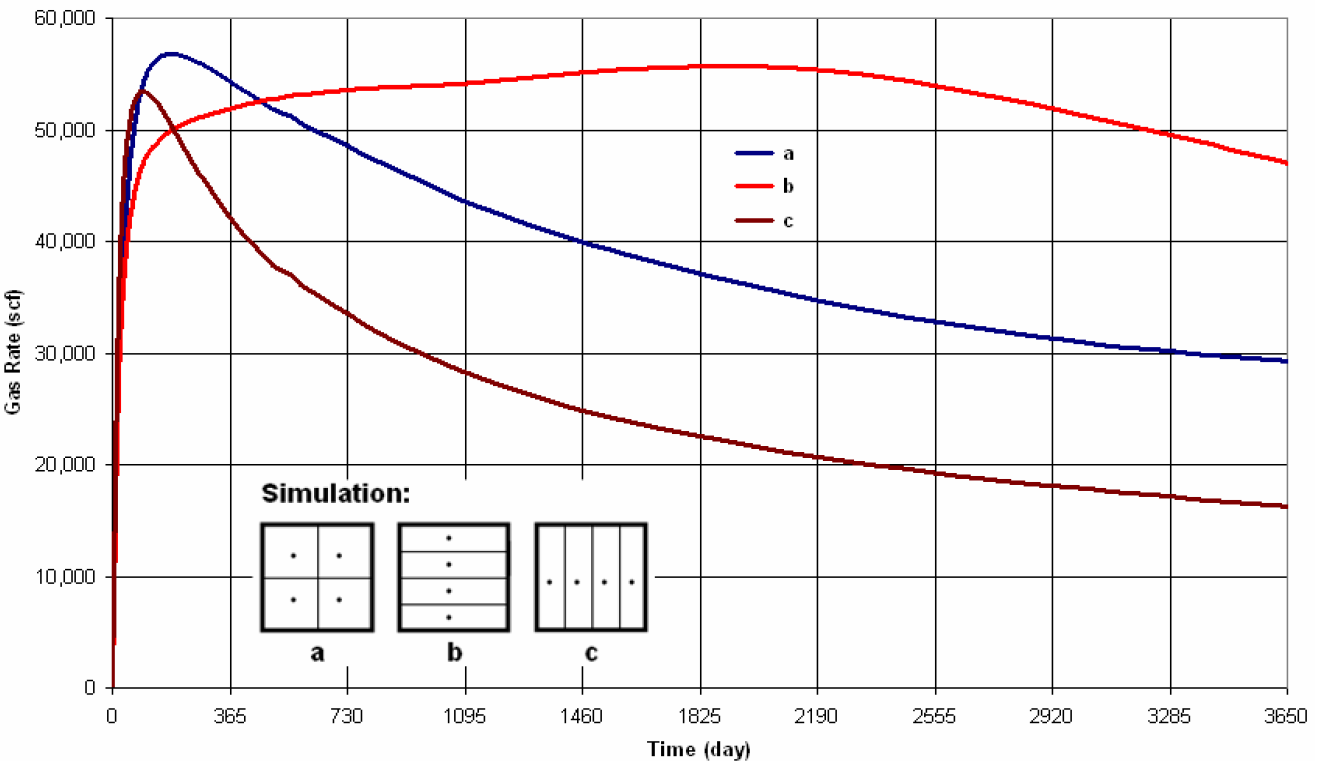
Simulation work by Zulkarnain (2006) was undertaken to evaluate the impact of anistropy on vertical well production. For permeability anisotropy modeling, permeability along x-axis is set as 1 md and permeability along y-axis is set as 0.01 md. In this case, the reservoir provides more flow-path for the fluid to flow along the x-axis. The rate of depletion along the x-axis is higher than the rate of depletion along the y-axis.
In the simulation work below, it shows that scenario A has the highest gas rate in the first year of production. Scenario B peaks the latest but it has the highest gas rate compare to others for almost the late 9 years. It indicates that scenario B is the best well placement method regarding to the permeability anisotropy. It also will be more useful if we also see the cumulative gas production for these simulations.
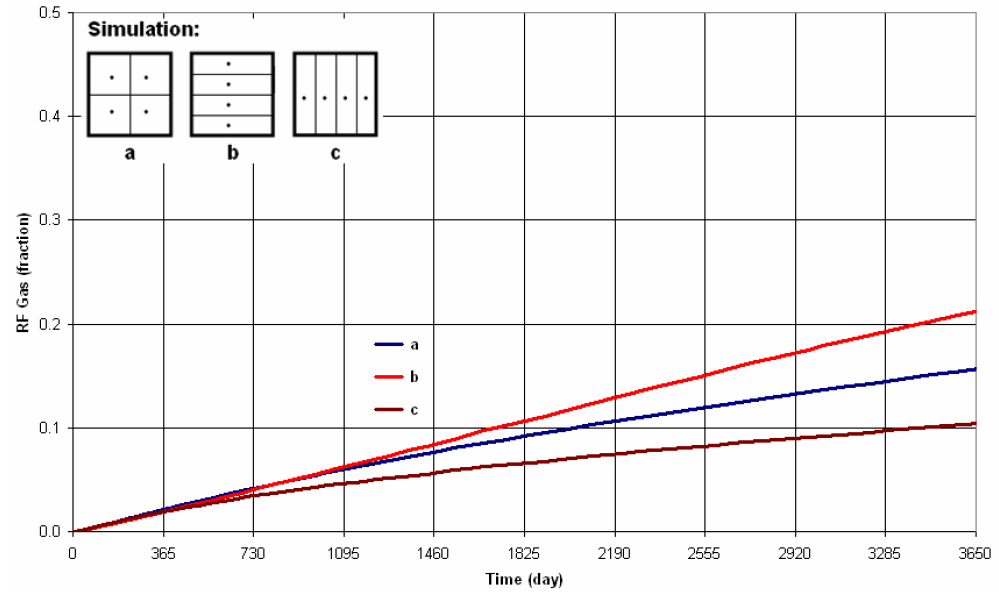
From the figure above, we see that for 10 years simulation scenario B produces the highest cumulative gas production. Scenario B produces total gas about 21 percent for ten years simulation. Scenario A and scenario C produce total gas about 16 percent and 10.5 percent respectively.
See Also:
References:
-
Zulkarnain, Ismail, Simulation study of the effect of well spacing, effect of permeability anisotropy, and effect of Palmer and Mansoori model on coalbed methane production, 2006, Texas A&M University.
-
Bustin, R. M., Geology & Some Engineering Aspects of Coalbed Methane, 2001, CBM Solutions.
-
Clarkson, C. R., Unconventional Reservoir Rate-Transient Analysis: Volume I and II, 2021, Gulf Professional Publishing
-
Sinurat, Pahala Dominicus, The Optimization of Well Spacing in a Coalbed Methane Reservoir
2010, Texas A&M -
Law, B.E., 1983. The relation between coal rank and cleat spacing: implications for the prediction of
permeability in coal. Proc. Int. Coalbed Methane Symposium, II. p. 435-442. -
R. R. Tonnsen, A Study of the Relationships Between Permeability, Stress, & Pore Volume Compressibility in Deep Coalbed Methane Environments, M. Sc., Colorado School of Mines, 2006.