
Introduction
The term “matrix shrinkage” effect occurs when the volume of the coal matrix decreases during desorption; this in turn causes fractures to dilate. It is believed that this phenomenon is related to surface energy of coal during desorption—release of gas increases coal surface energy, which causes coal surface to contract during desorption. Matrix shrinkage is interpreted to be the primary cause of large absolute permeability increases in Fruitland coal Fairway wells of the San Juan Basin, as well as permeability growth observed in the Horshoe Canyon Coals (Alberta, Canada)
Fruitland Coal Example
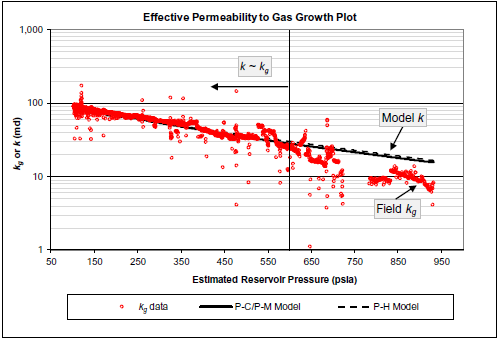
It is well documented that CBM wells in the Fruitland coal Fairway in the San Juan Basin exhibit strong evidence of absolute permeability growth, inferred to be caused by matrix-shrinkage effects. This conclusion was made by Clarkson et al (2007, 2008), Gierhart et al (2007), and others. An example of permeability growth during depletion for a Fruitland Coal well (referred to as “FCF well 2” by Salmachi et al (2018) is shown below
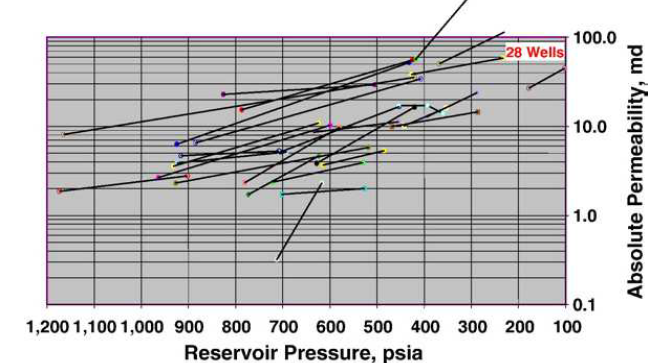
Geirhart et al (2007), summarized the permeability measurements from infill wells in the NE section of the production fairway. The figure below shows absolute permeability vs depletion for 28 infill wells, each well with two pressure buildup measurements.
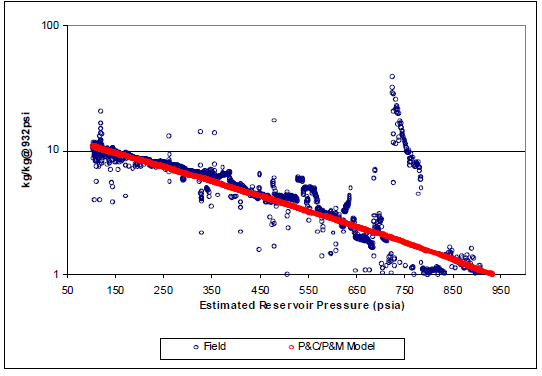
Clarkson et al, illustrated permeability GAIN (permeability growth) in the San Juan and showed a 10 fold increase in the effective gas permeability from 932 psi to 1000 psia as shown below:
References
-
Clarkson, C.R., Jordan, C.L., Gierhart, R.R., Seidle, J.P., 2008. Production data analysis of coalbedmethane
wells. SPE Reservoir Evaluation & Engineering, 11(2), 311-325. -
Clarkson, C.R., 2008. Case Study, Production Data and Pressure Transient Analysis of Horseshoe
Canyon CBM Wells, CIPC/SPE Gas Technology Symposium 2008 Joint Conference. Society of
Petroleum Engineers, Calgary, Alberta, Canada. -
Clarkson, C.R., Bustin, R.M., 1997. Variation in permeability with lithotype and maceral composition
of Cretaceous coals of the Canadian Cordillera. International Journal of Coal Geology, 33(2), 135-151. -
Clarkson, C.R., Bustin, R.M., Seidle, J.P., 2007. Production-Data Analysis of Single-Phase (Gas)
Coalbed-Methane Wells. SPE Reservoir Evaluation & Engineering, 10(3), pp. 312-331. -
Clarkson, C.R., McGovern, J.M., 2005. Optimization of coalbed-methane-reservoir exploration and
development strategies through integration of simulation and economics. SPE Reservoir Evaluation &
Engineering, December, 502-519. SPE 88843. -
Clarkson, C.R., Pan, Z., Palmer, I.D., Harpalani, S., 2008b. Predicting Sorption-Induced Strain and
Permeability Increase With Depletion for Coalbed-Methane Reservoirs. SPE ATCE, Denver, Colorado. -
Clarkson, C.R., Pan, Z., Palmer, I.D., Harpalani, S., 2010a. Predicting Sorption-Induced Strain and
Permeability Increase With Depletion for Coalbed-Methane Reservoirs. SPE Journal, 15(1), pp. 152-
159 -
Zhejun Pan, Luke D. Connell, Modelling Permeability for Coal Reservoirs: A Review of Analytical Models for Testing Data. CSIRO Earth Science and Resource Eng, n.d