
Introduction
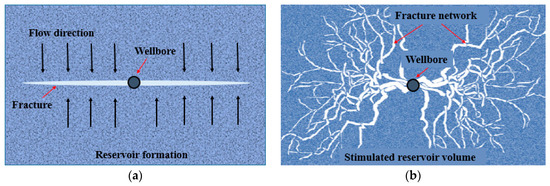
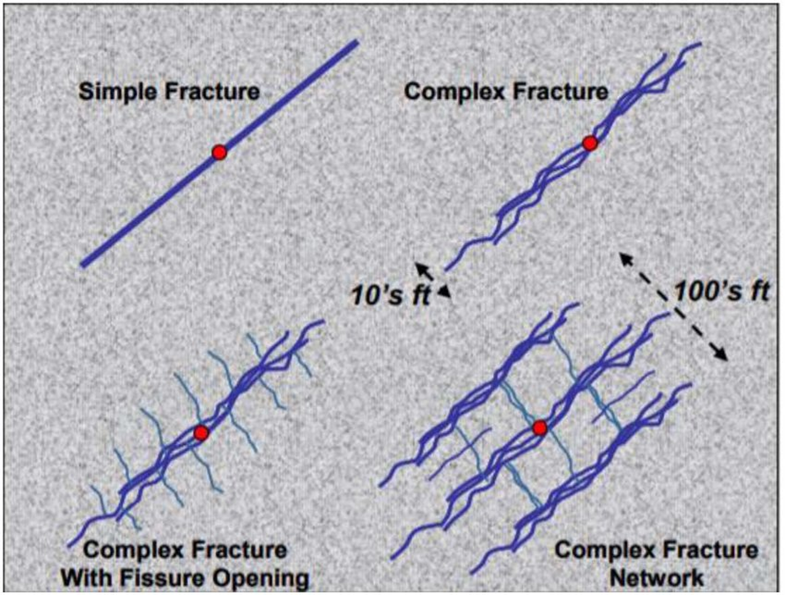
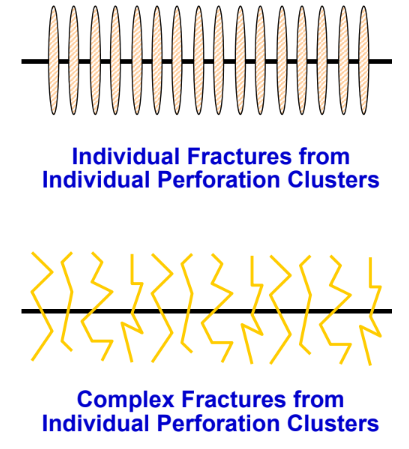
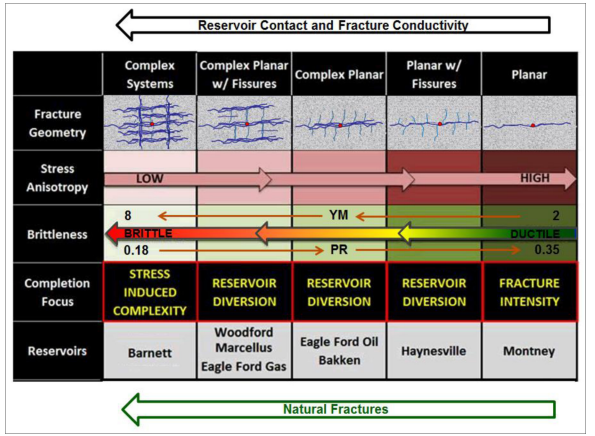
Modern analysis techniques such as micro-seismic imaging has demonstrated that, unlike single fracture planes typical of conventional sands (maybe even tight conventional), true shale reservoirs can have complex fracture systems (brittleness leads to branching fractures) that spread in multiple directions. Multistage fracture treatments often overlap and intersect in intricate ways with natural fractures in the rock. This region is often called Stimulated Rock Volume or SRV.
Some sources such as Blasingame [2015] that could possibly be considered rubbilized or pulverized reservoir.
Mineralogy and Fracture Network
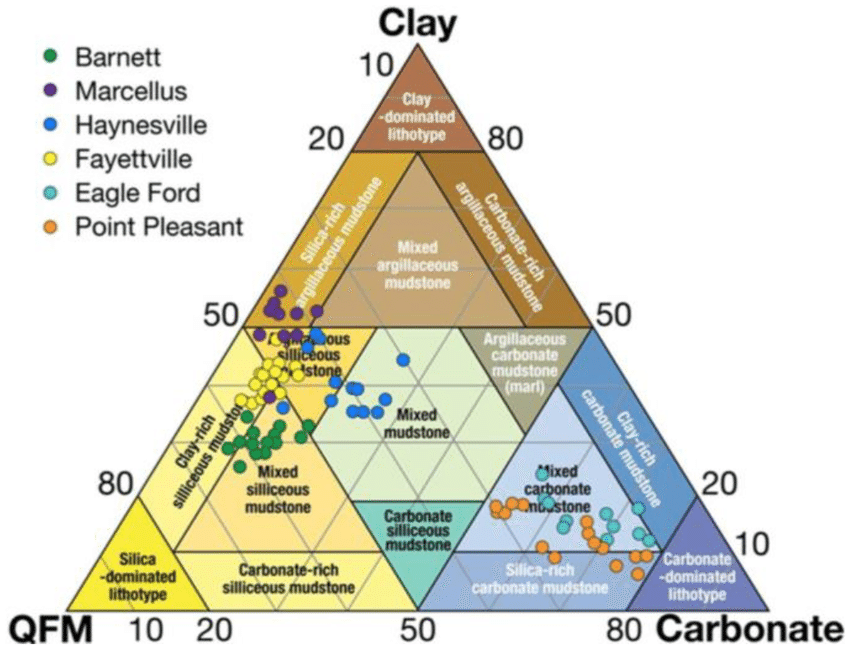
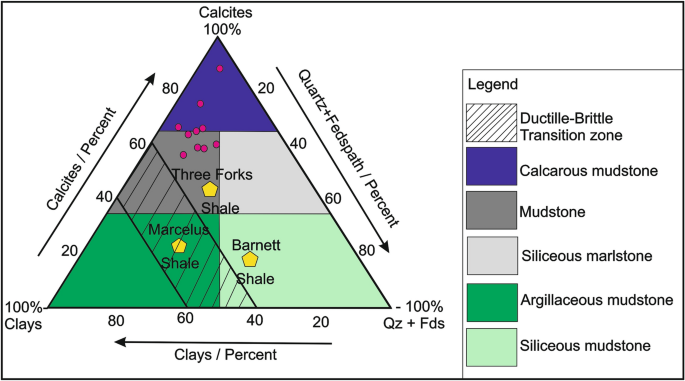
Often the difference between traditional bi-wing fractures and fracture networks is a function of mineralogy (brittleness scale) and stress in the reservoir. In general, the more QFM (like the Barnett in the USA, or the Horn River in Canada), the greater the likelihood of a fracture network (In the image below, QFM = Quartz, Feldspar, and related silicates).
SRV Model in AFA
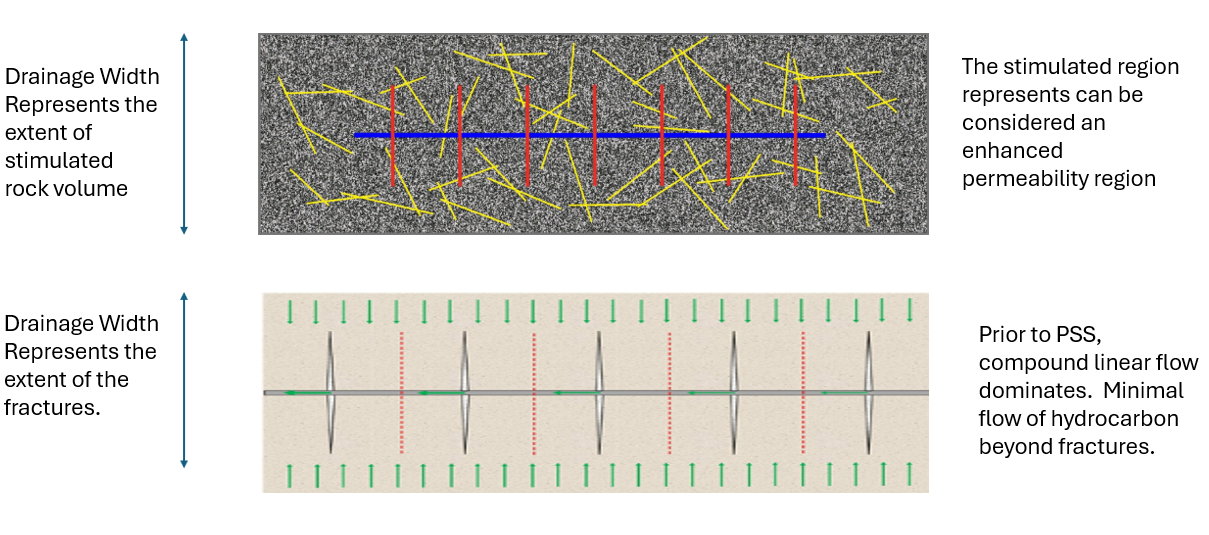
A Stimulated Reservoir Volume (SRV) is the drainage area of the hydraulic fractured horizontal well. Quite often for simplicity, an SRV is defined as rectangular geometry limited to the hydraulic fractures half-length and effective wellbore drainage length (This model basically assumes all flow is perpendicular to the horizontal well). It is also pften assumed that the production of ultra-low permeability reservoirs will come from ONLY inside the SRV only. Significant research and work was performed at Texas A&M University, generally under the guidance of Dr. R. A. Wattenbarger. This included the work of El-Banbi [1998], Bello [2010], Samandarli [2011], Tivayanonda [2012], and many others.
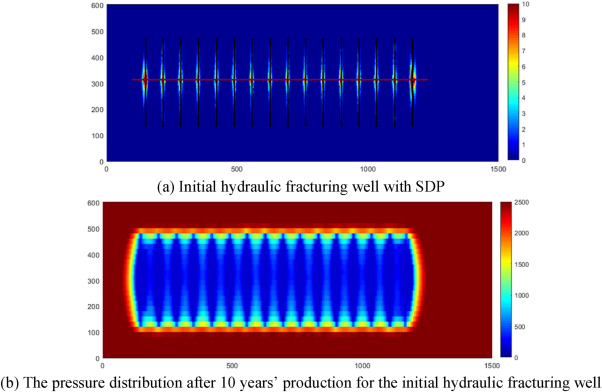
Anderson et al. (2010) found that the amount of contribution outside SRV depends on the matrix permeability and the interface area between SRV and non-stimulated reservoir. It is showed that with matrix permeability of 1e-6 md, the effect of outside SRV shows around 230 years after production and with matrix permeability of 1e-4 md, the contribution outside SRV appears around 2 years. In the simulated Barnett example below (which was simulated using 0.001 md at Texas A&M by Zhang et al [2015]), the pressure distribution after 10 years is only representative the stimulated area.
Ozkan et al [2009], used analytical solution of trilinear flow model and showed that the effect of outside SRV will not affect the production during the life of the well with practical matrix permeability of unconventional reservoir.
See Also:
References:
-
T. A. Blasingame, Reservoir Engineering Aspects of Unconventional Reservoirs, SPEE Lunch Presentation, 08 July 2015.
-
Anderson, D.M., Nobakht, M., Moghadam, S. et al. 2010. Analysis of Production Data
from Fractured Shale Gas Wells. Paper SPE-131787-MS presented at the SPE
Unconventional Gas Conference, Pittsburgh, Pennsylvania, 23-25 February. doi: 10.2118/131787-ms -
R. A. Bello, Rate Transient Analysis in Shale Gas Reservoirs with Transient Linear Behavoir, PhD Thesis, Texas A&M University, 2009.
-
A M. Almarzoo , The Implications and Flow Behaviour of the Hydraulically Fractured Wells in Shale Gas Formation. M.Sc Thesis, Texas A&M, 2010.
-
Orkhan Samandarli, A New Method for History Matching and Forecasting Shale Gas/Oil Reservoir Production Performance with Dual & Triple Porosity Models, M. Sc. Thesis, Texas A&M, 2011
-
Ozkan, E., Brown, M.L., Raghavan, R.S. et al. 2009. Comparison of Fractured Horizontal-Well Performance in Conventional and Unconventional Reservoirs. Paper SPE-121290-MS presented at the SPE Western Regional Meeting, San Jose, California, 24-26 March. doi: 10.2118/121290-ms
-
El-Banbi, A.H. 1998. Analysis of Tight Gas Wells, Ph.D. Dissertation. Texas A&M University, College Station, Texas.
-
J. Zhang, A. Kamenov, D. Zhu, & A.D. Hill, Development of New Testing Procedures to Measure Propped Fracture Conductivity Considering Water Damage in Clay Rich Shale Reservoirs: An Example of the Barnett Shale, Journal of Petroleum Science & Technology, November 2015.