
Introduction
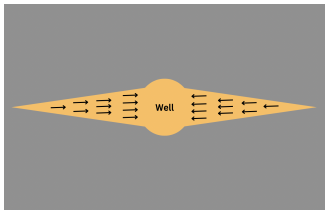
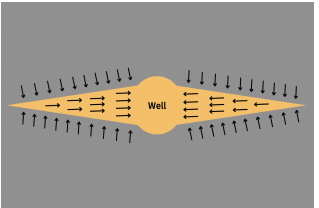
Flow regimes are pattens of fluid flow (i.e. streamlines) occurring the reservoir due the configuration of the wellbore - reservoir geometry etc. The illustration below shows some typical flow regimes for a finite conductivity fracture .
In the first figure, “Linear Fracture Flow” is a flow regime (streamlines are parallel to each other), while the 2nd plot represents “Bilinear flow” regime (streamlines are perpendicular). Analytical and numerical pressure mapping can be used to visualize streamlines during the different stages of life of a well.
In general, the most common flow regimes are:
-
Radial Flow.
-
Bilinear (Fracture) Flow. See
-
Linear (Linear) Flow
-
Linear (Channel) Flow
Interpreting flow regimes (start and end) is a significant component of rate transient analysis
Common Transient Models
Some of the more traditional flow regimes in conventional RTA and PTA are listed below:
See Also:
-
Stimulated Rock Volume (SRV) models
References:
-
Automated Rate Transient Analysis in Transitional Flow Using the Logistic Function, Undergraduate Thesis by Matthew Willenbring, University of Texas