
Introduction
A wireline formation tester is an open hole wireline tool. A idealized description of the tool is shown below. After a packer is set, a probe is driven through the center of the packer (and filter cake etc) into the formation of interest.
The pressure is measured continuously, and the signal from the transducer is sent to surface through wireline. The tool can be reset to measure as many intervals as desired.
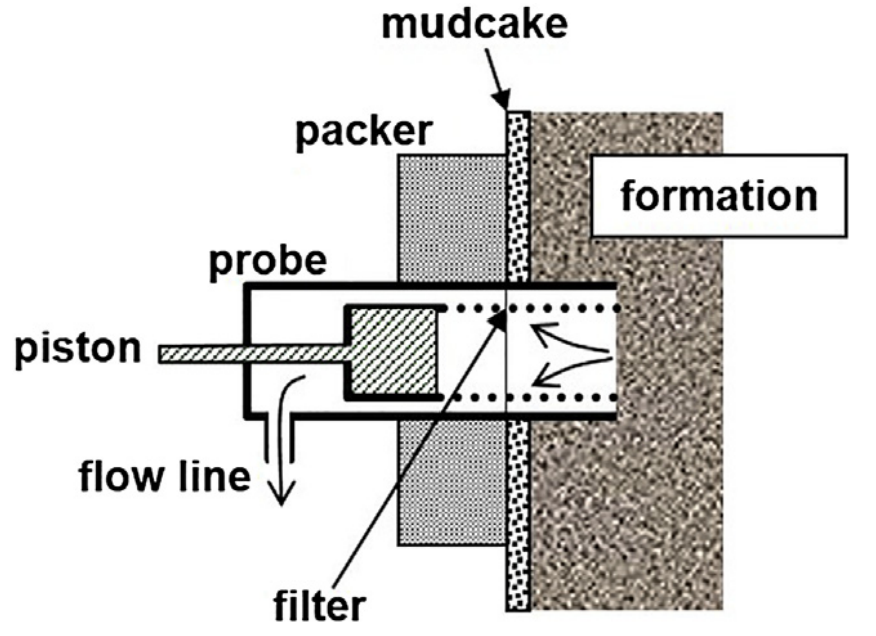
Perhaps the most widely used form of WFT pressure-transient data is that derived from small-volume drawdowns and buildups during a pressure test.
Small Volume Tests
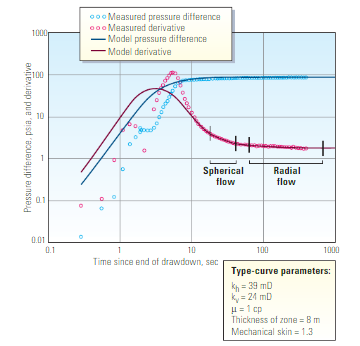
The flow regime that develops during these tests is typically spherical flow in an infinite medium; hence, the mobilities derived from these sorts of pressure-transient tests are spherical mobilities and need to be converted to radial mobilities to quantitatively compare the tests. Also, it is possible that the radius of investigation is within a damaged region.
Large Volume Tests
The primary differences between using small-volume tests and extended pumping stations for pressure-transient information are
-
The pressure pulse that is propagated extends well beyond the near-wellbore region, typically a few decameters into the formation.
-
The viscosity of the primary fluid being investigated is known.
-
Skin can be compensated for; therefore, the resulting mobility thickness from the interpretation is skin-independent.
As shown in the Bourdet plot below, both spherical and radial permeability can be estimated ultimately providing an estimate of vertical permeability. In shorter tests, it is possible that only spherical flow is observed.
References
-
“Extracting More From Wireline Formation Testing: Better Permeability Estimation,” by S.R. Ramaswami, P.W. Cornelisse, SPE, H. Elshahawi, M. Hows, and C.L. Dong, SPE, Shell, prepared for the 2016 International Petroleum Technology Conference, Bangkok, Thailand, 14–16 November.