
From the Society of Petroleum Evaluation Engineers (SPEE) Monograph 4 , the following workflow (modified From Erdle [2017] and John Seidle [2017]) is suggested the following.
|
Step |
|
|
|---|---|---|
|
1 |
Assess Data Viability and Correlation |
|
|
2 |
Construct Diagnostic Plots |
Refer to Pseudo RTA methods: Pressure Normalized Decline Analysis Specialized Plots |
|
3 |
Identify Flow Regimes which may include MFHW Linear & Compound linear flow, as well as PSS. According to Lee [2013], the minimum flow regime plot is Log[q] vs Log [t] |
|
|
4 |
Analyse with Simple Models |
Refer to: |
|
5 |
Analyse and Forecast with analytical models such as RTA and/or PSS. Peter Best [2017 of Credit Suisse suggested doing group runs or RTA and generating a base type well from the analysis. Strickland, Purvis,and & Blasingame [2011] indicated:
|
Refer to: FMB and Rate Transient Analysis (RTA) & RTA Diagnostics include: |
|
6 |
History Match with Numerical Simulator |
|
Strickland, Purvis, & Blasingame [2011]
-
Simulation, rate-transient analysis, and decline curves can be used to forecast production from shale wells with reasonable accuracy – when used appropriately.
-
If the quantity (or quality of the data) is sufficient to use all three (3) of the methods, decline curve analysis is likely to be the most subject to error, especially during early-times.
-
Decline curves should be informed by simulation or rate-transient analysis when feasible.
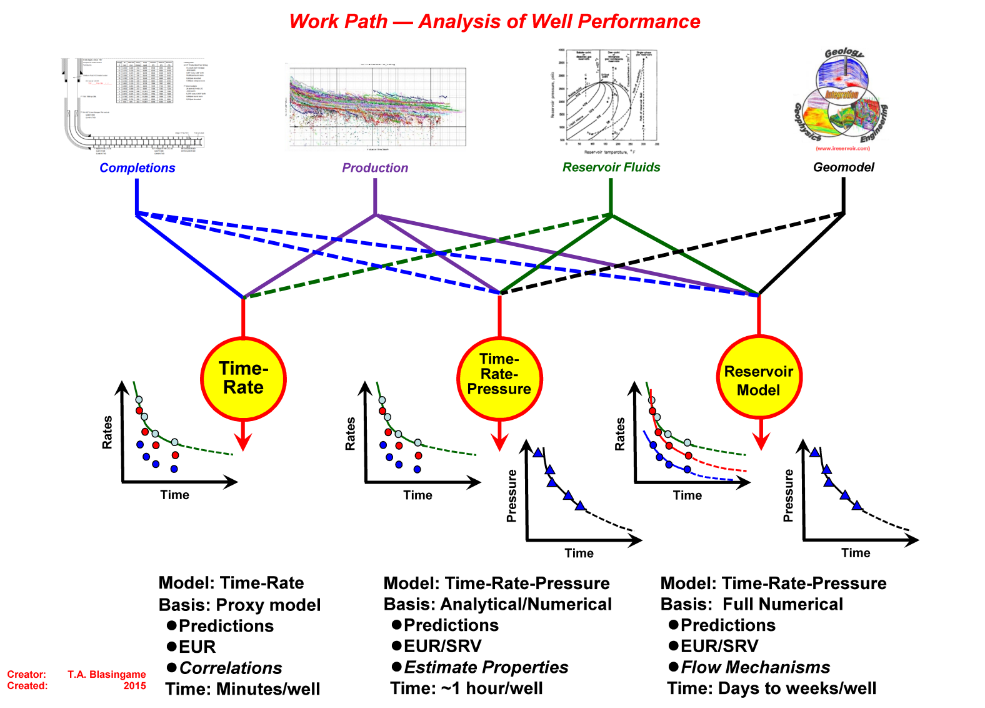
The SPEE workflow follows the work of Blasingame [2019] very closely as shown in the figure below:
References:
-
Jim Erdle, “An Overview of SPEE Monograph # 4 “Estimating Ultimate Recovery of Developed Wells in Low-Permeability Reservoirs”, 16 May 2017, Ryder Scott Conference
-
John Seidle “Adaptation of SPEE Monograph 4 to Wyoming Horizontal Plays“, October 12, 2017
-
Peter Best, SPEE Monograph 4: Current Best Practice for Estimating Ultimate Recovery of Developed Wells in Low-Permeability Reservoirs. November 16, 2016.
-
R. Strickland, D. Purvis, & T. A. Blasingame, Practical Aspects of Reserve Determination for Shale Gas, SPE 144357, 2011.
-
T. A. Blasingame, Reservoir Engineering Aspects & Forecasting of Well Performance in Unconventional Reservoirs, SPEE Presentation, 02 May 2019, Brookhaven College.