
Below is the ideal data requirements to operate any of the AFA modules. Please note, without basic wellbore pressures, petrophysical data, etc, only SPAD modules are functional.
|
RTA, Tank, Simulation & Physics Models |
|
|
||
|---|---|---|---|---|
|
PVT Properties |
Formation Properties |
Production Data |
Pressures |
Completion Data |
|
GAS Wells
Oil Wells
|
|
If only rates are provided, only SPAD modules are functional in AFA. |
Flowing Oil, Gas, Water
Oil or Pumped Wells
|
|
PVT and Formation Properties
-
Formation properties (Net Pay, Porosity, Fluid Saturations, Formation Temperature - see above) can be approximated to a certain extent. Most of these values are used to back-calculate effective formation parameters (permeability, drainage area) from the observed productivity index.
-
Forecasts and delivery profiles are somewhat immune to errors or approximations in these values as our data-driven models honour the observed productivity index. The biggest impact is on parameters used for reservoir characterization.
Concerns about Legacy Data & Data Correlation
-
This discussion probably applies mostly to Transient Models & Flow Regimes
-
Perhaps the most important issue for the estimation of reservoir properties (reservoir characterization) is to acknowledge that legacy production data (i.e., data which are 20+ years old) may contain neither the quality, nor the frequency sufficient to produce competent estimates of reservoir properties (reservoir characterization) [Anderson et al, 2006]. However, forecasting capability based on effective reservoir properties can still be reliable.
-
This is an extraordinarily simple check, but data which have no correlation probably will not provide any diagnostic value. Refer to Rate-Pressure Correlation for further details.
-
Event analysis is related to Rate-Pressure Correlation and reflects changes in completion (tubing size, stimulation, and other completion data).
Daily vs Monthly Data
-
In Rate Transient Analysis (RTA), daily production data is preferred over monthly data, especially when analysing the transient (early-time) portion of well performance (detailed skin, fracture, and permeability characterization). Daily data captures the fine-scale changes in flow rate over time, which are crucial for identifying transient flow regimes - but not necessarily PSS.
-
Some recommendations for analysis are:
|
Data Detail |
Best Application |
Deliverables |
|---|---|---|
|
Daily Data (Rates & Pressures) |
All Modules
|
Characterization
Forecasting
|
|
Monthly Data (Rates and Pressures) |
Most Modules
|
Characterization
Forecasting
|
|
Rates Alone |
Limited Modules
|
Forecasting
|
Initial Reservoir Pressure
-
Initial pressure is more critical than basic formation properties, as it significantly impacts material balance calculations!, influencing both forecasts and well deliverability.
-
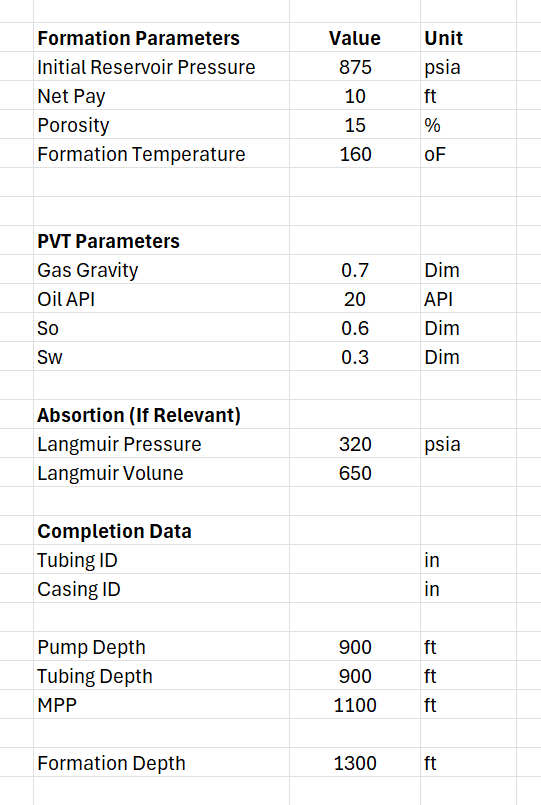
A common initial pressure value can be applied to multiple wells unless the client or user specifically requests discrete values for each well. A simple word document, see below, with some basic values can be forwarded to Predico for pre-population.
The Importance of Flowing Pressures in RTA, Tank, and Physics Models
-
Flowing pressures play a critical role in many of our physics models, as they provide a direct measure of pressure depletion within a reservoir during fluid production.
-
By analysing flowing pressures, engineers can identify flow regimes, estimate key reservoir properties such as permeability and fracture conductivity, and predict future production decline. Understanding the relationship between flowing pressures and production rates over time allows for more accurate reservoir performance forecasting and optimization.
-
Predico recommends providing all pressure data sources available to your organization to allow AFA to find the best solution for you.
-
Refer to Pressure Sources & Types of Pressures for more detail as well as potential approximations for bad or missing data.
-
-
Predico is willing to work with you to integrate and collate when rates with pressures are stored in data sources or data bases.
FYI: Predico Software has a simplified manual pressure input across all modules when digital pressure collection is not available.
An estimated pressure is better than no pressure!
Import/Export Advice
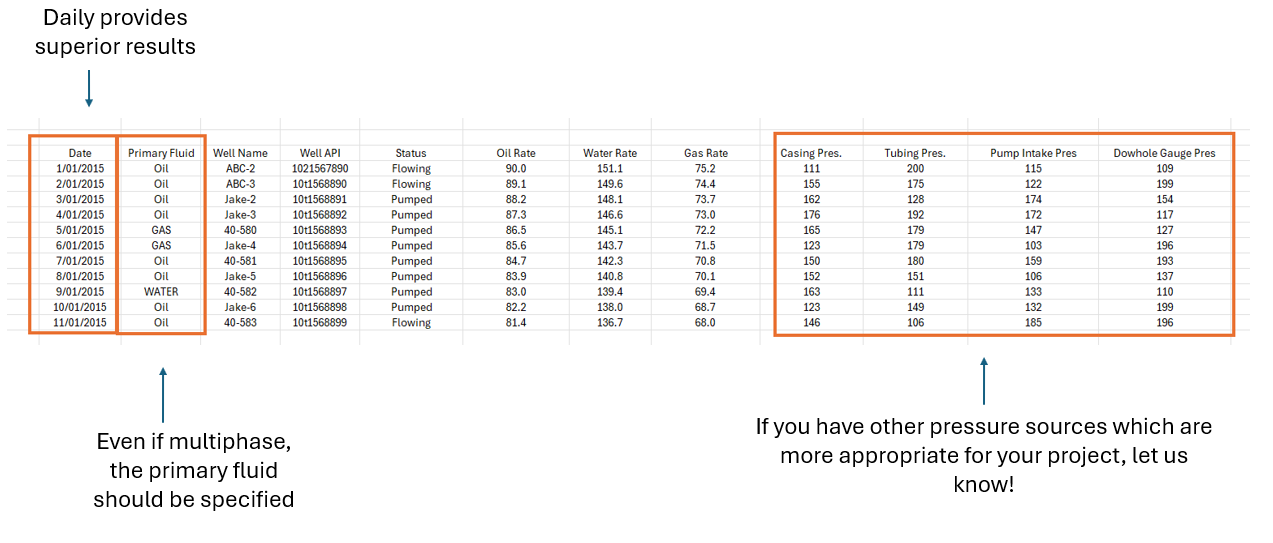
We support various tabular formatted files, including CSV, XLS, and XSLX, as well as databases such as SQL, Snowflake, and Aries. In AFA , all wells must be classified as Gas, Oil, or Water. Therefore, a primary producing fluid or well type classification is required.
This is the example of .csv or excel file that ideal for importing into AFA
Acceptable Units for Time-Series Import
|
Variable |
Field |
Metric |
|---|---|---|
|
Gas Rate |
mscf/d mmscf/d |
10m3/d or Em3/d |
|
Oil Rate |
bbl/d |
m3/d |
|
Water Rate |
bbl/d |
m3/d |
|
All pressure sources |
psia |
kPaa |
References
-
D. M. Anderson, G.W.J. Stotts, L. Mattar, D. Ilk, and T. A. Blasingame, Production Data Analysis — Challenges, Pitfalls, Diagnostics, 2006 SPE Annual Technical Conference and Exhibition held in San Antonio, Texas, U.S.A., 24–27 September 2006.