
Introduction
A sediment or sedimentary rock is defined to be anisotropic with respect to permeability when the magnitude of permeability at a given sample point changes with the direction of fluid flow through that sample. Permeability anisotropy in sediments is thought to be caused by the presence of grain-scale or layer-scale heterogeneities which have a preferred orientation.
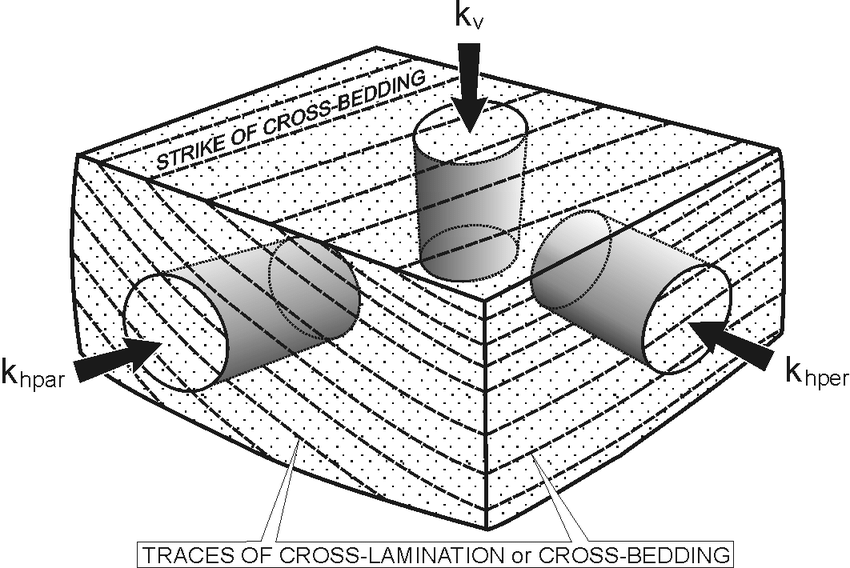
In simple terms, you can consider permeability to have a different value in the x, y, and z direction of a 3D reservoir system. In the example below, the schematic shows how layering, and lamination etc. may cause direction permeability effects (this image is based on the Virgelle Member, Milk River Formation, Writing-on-Stone Provincial Park, southern Alberta).
References:
-
Meyer, Rudi and Krause, Federico, Permeability anisotropy and heterogeneity of a sandstone reservoir analogue: An estuarine to shoreface depositional system in the Virgelle Member, Milk River Formation, Writing-on-Stone Provincial Park, southern Alberta, Bulletin of Canadian Petroleum Geology, 2006/12/01