
Introduction
The Society of Petroleum Evaluation Engineers (SPEE) Monograph 4 was a response to industry questions or concerns about any special United States (US) reserves reporting regulations with respect to unconventional resources (excluding CSG).
Previously, the SPEE Monograph(s) were only acknowledged the following traditional technologies (with reservations) as acceptable to Securities & Exchange Commission (SEC) Staff for unconventionals.
-
Decline curve analysis with Arp's Decline including modified hyperbolic etc.
-
Analogy (Analogs for Tight Gas Sands (& other Resources) ) & Type Wells
-
Volumetrics
-
Reservoir Simulation
SPEE Monograph 4 was published to include:
-
Alternative Simple Decline Models
-
Rate-Transient Analysis
-
Modified and enhanced reservoir characterization & simulation techniques.
According to David Fulford [2022], Flow Regime analysis is a recommended best pracice described in [SPEE] Monograph 4, and well as serve an important role in … [SPEE] Monograph 5.
There was a need to demonstrate that the technology for forecasts must meet criteria of “reliable technology“; that is, field tested and demonstrated to provide reasonably certain results. In 2013, John Lee stated that “we are using reserves estimation practices developed during the last century for conventional reservoirs“.
According to Erdle [2017], a sample of unconventional systems include:
-
Light tight oil/shale oil
-
Shale/Tight Gas
-
Coal Seam Gas (CSG) or Coal Bed Methane
-
Basin Cantered Gas
The following is specifically excluded:
-
Oil Sands (Bitumen)
-
Gas Hydrates
-
Oil Shale (Kerogen)
Select Recommended practices included:
Arps Decline
Arp's Decline which is considered simple and an adequate empirical match and universality used by everyone from practicing engineers to financial backers. Some recommendations are:
-
Best use is for well level, and higher frequency data
-
Plot all phases and all pressures simultaneously.
-
“b“ values should be established for well and reservoir type based on significant well data
-
Observed “b“ values can be as high as “2“ but should be constrained with a terminal decline rate.
-
Strength
-
Only option if you have public domain rate data.
Limitations
-
The rate equation can have long tail and erroneously high recovery. Modified hyperbolic was introduced to curb tail, but requires more parameters leading to increased non-uniqueness.
-
Forecasts have very strict assumptions as discussed here Arp's Decline
Rate Transient Analysis
Strengths
FMB and Rate Transient Analysis (RTA) are analytical (and/or numerical) models used to analyse and forecast well performance.
In addition to forecast well production and EUR, objectives of this work can lead to:
-
Well Completion effectiveness such as Wellbore Skin and Formation Damage
-
Determine well and reservoir properties
-
Data-Driven in that it does not require geological models.
Limitations
-
Sometimes perceived as a Single Well Analysis, but Pool RTA does exist. John Lee [2020] indicated that Science Based Models can honour interference. At a minimum, RTA models can model vary data-driven well spacing to model interference effects.
-
Sometimes perceived as Single Phase
-
Homogeneous Reservoirs
-
Deterministic Forecasts, which is a limitation solved by Predico.
-
Thorough RTA is requires substantial amount of time, a challenge which has been resolved by Predico AFA through RULON: Automation & Group Runs .
-
It was previously believed that RTA is not possible to do in a reasonable amount of time if hundreds or thousands of wells are in the data set [Filler, 2014].
-
As a result, Filler [2014] suggested to use a Fetkovich Curve (see Fetkovich & Carter Plots , but that procedure requires the same data and computational effort as FMB and Rate Transient Analysis (RTA) but without the quality of modern methods.
-
Numerical Simulation
Strengths
Numerical methods can handle all kinds of complex physics including
-
Multiphase Flow
-
Reservoir Heterogeneity
-
Well Interference ((technically, we can also do this with PSS Models )
-
Changing reservoir/completion parameters (technically, we can also do this with PSS Models )
Limitations
-
History matches are non-unique (Automatic History matching can produce multiple solutions). Predico indicates that this is a possible limitation of any physics based method. There can be significant degrees of freedom.
-
Require a facies driven geological model.
-
Quality work requires a substantial amount of time.
See Also:
Fun Fact:
There have been many different organizations and institutes involved in oil and gas reserve guidelines and practices. From Ryder Scott [2015], a limited set is shown below:
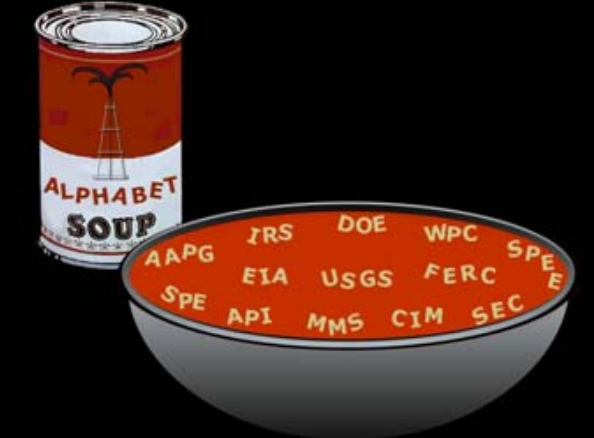
According to Barker and Gunn [2013], there were approx. 33 reporting styles, and are there to help investors make informed decisions.
The SEC (United States) and the Petroleum Resources Management System (US +International) have emerged as the primary two methods for most of the world.
The PRMS is a consolidation and supported by Society of Petroleum Engineers (SPE), World Petroleum Congress (WPC), American Association of Petroleum Geologists (AAPG), European Association of Geophysical Engineers (EAGE), the Society of Petrophysicists and Well Log Analysts (SPWLA) and the Society of Evaluation Engineers (SPEE).
From 2010, the Securitise & Exchange Commission (SEC) adopted many of the principles of the PRMS within its own framework. In addition, the UN and SPE have signed a memorandum of understanding which may lead to further consolidation.
Countries like Canada use their own method (COGE). There are also Russian and Chinese standards.
References:
-
Jim Erdle, “An Overview of SPEE Monograph # 4 “Estimating Ultimate Recovery of Developed Wells in Low-Permeability Reservoirs”, 16 May 2017, Ryder Scott Conference
-
Stuart L. Filler “Production Forecasting in Ultra-Low Permeability Reservoirs: Proposed Methodology“, October 2, 2014.
-
John Lee, Monograph 4, Monograph 3,… and the SEC, 2 September 2015. Ryder Scott Conference.
-
Anthony Corrie-Keilig, Rigorous Gas Field Production Data Analysis, APPEA 2019.
-
John Lee, Are Our Proved Shale Reserves Reasonably Certain? Ryder Scott Conference, 2013
-
John Lee, How Can We Take Possible Well Interference into Account in Production Forecasting, 16 September 2020.
-
Don McMillian, SPE-PRMS & Reserves Reporting in Australia, PESA News., 2009/2010
-
Geoff Barker and Bruce Gunn, ASX Reserves and Resources Reporting for Oil & Gas Companies. July 2013.