
Introduction
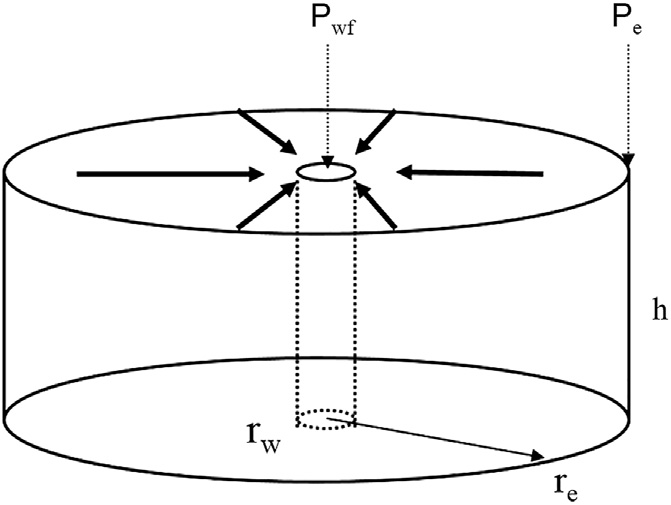
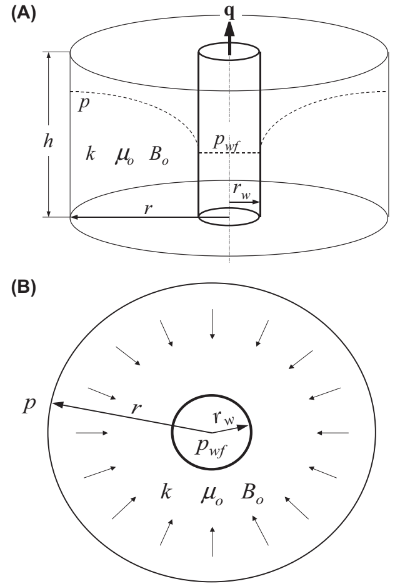
In the absence of severe reservoir heterogeneities, flow into or away from a wellbore will follow radial flow lines at a substantial distance from the wellbore. Because fluids move toward the well from all directions and coverage at the wellbore, the term radial flow is used to characterize the flow of fluid into the wellbore.
The radial models are often represented by the work by Van Everdingen and Hurst (1949). Radial flow can be represented by the graphic below. The idealized pressure curves and isopotential lines for a bounded radial flow system are also shown.
|
|
|
|---|---|
|
|
No-Flow Boundary Condition: Constant Terminal Pressure Solution
The solution presented below assume the flow rate is constant at the wellbore radius, and that the pressure profile around reservoir (moving away from the radius) is determined as a function of time and pressure.
For the no-flow outer boundary condition, the solution given in Laplace space is:

Nomenclature (Dimensionless Units)
reD = Dimensionless reservoir radius, or the radius to the boundary condition
rD = Dimensionless observation point, most commonly rD=1
s = Laplace parameter, or Laplace space equivalent of time.
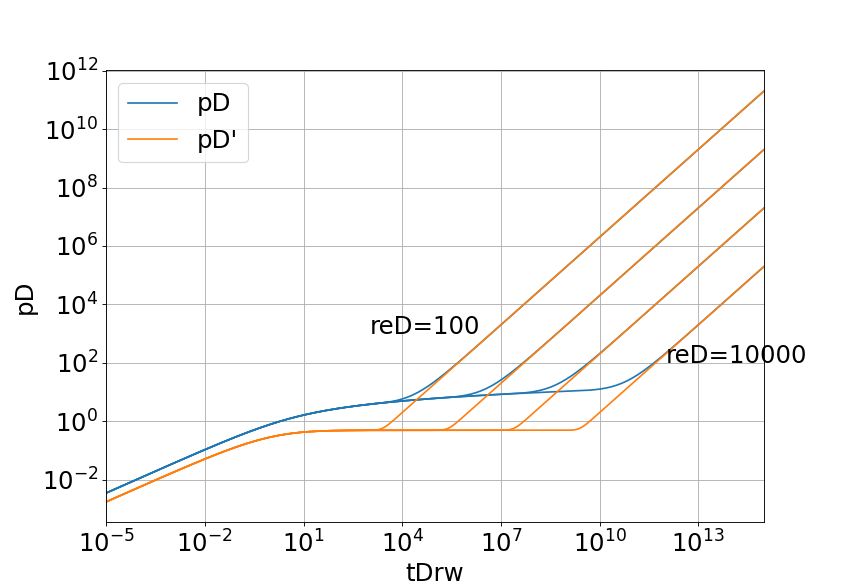
Below is the Bourdet (Well Testing) of the Van Everdingen and Hurst Solution, for no flow boundaries at:
-
reD =100, 1000, 10000 and 100000
Constant Pressure Boundary Condition
The constant-pressure solution is widely used as an approximation for water influx calculations.
For the constant-pressure boundary condition, the solution given in Laplace space is:

In both scenarios above fs is a Dual Porosity function (fs = 1 for no dual porosity effects). Solutions are inverted to real-space for use in AFA.
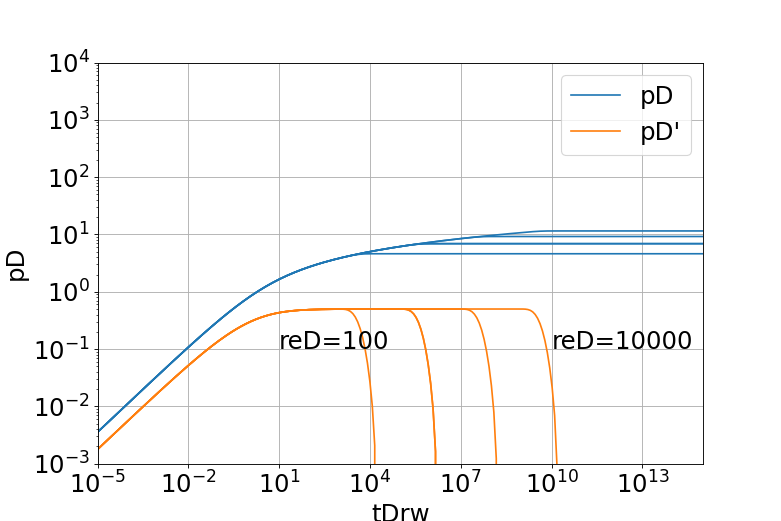
Below is the Bourdet (Well Testing) plot of the Van Everdingen and Hurst Solution, for constant pressure boundaries at:
-
reD =100, 1000, 10000 and 100000
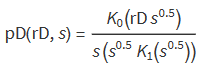
For completeness, the solution for infinite acting radial flow is given below:
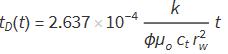
For most applications, the time dimensionless time defintions for oil are:
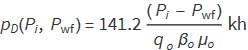
For most applications, the time dimensionless time definitions for gas are:
Nomenclature (Field Units)
k = permeability, md
φ =Porosity
μ = viscosity, cp
ct = total system compressibility, psia-1
rw = wellbore radius, ft
t = time, hours
Wellbore Skin
For a positive Wellbore Skin and Formation Damage , it is generally added to the dimensionless pressure solution as a constant such that:
pD(tD,skin) = pD(tD) +skin
For a negative skin, it may be added via an equivalent wellbore radius.
References:
-
Van Everdingen, A.F. and Hurst, W. (1949) The Application of the Laplace Transformation to Flow Problems in Reservoirs. Transactions of AIME, 186, 305-324.
-
Baker, R., Yarranton, H. Jensen, J. (2015) Practical Reservoir Engineering and Characterization, Gulf Publishing.
-
Ahmed, T., Meehan, D. N (2004) Advanced Reservoir Engineering, Gulf Professional Publishing
-
B. Guo, Well Productivity Handbook: Vertical, Fractured, Horizontal, Multilateral, and Intelligent Wells, 2008