
Introduction
The concept of Permeability Jail was first developed in 1992 during an unpublished multi-client study of Mesaverde tight gas sandstones in the eastern Green River Basin of the U.S. Although used informally for over a decade, the idea was not published until 2004 as part of a larger conceptual study of low-permeability reservoir systems. The basic notion is that in tight rocks there exists a saturation region in which the relative permeabilities to both gas and water are so low that neither phase has any effective flow capacity.
A hypothesis where capillary effects completely dominate flow behavoir in the reservoir. In such a situation, there may very little water or gas flow - a situation which could be called a “Permeability Jail”. Blasingame (2008) provides a description of permeabiltiy jail through relative permeability curves etc.
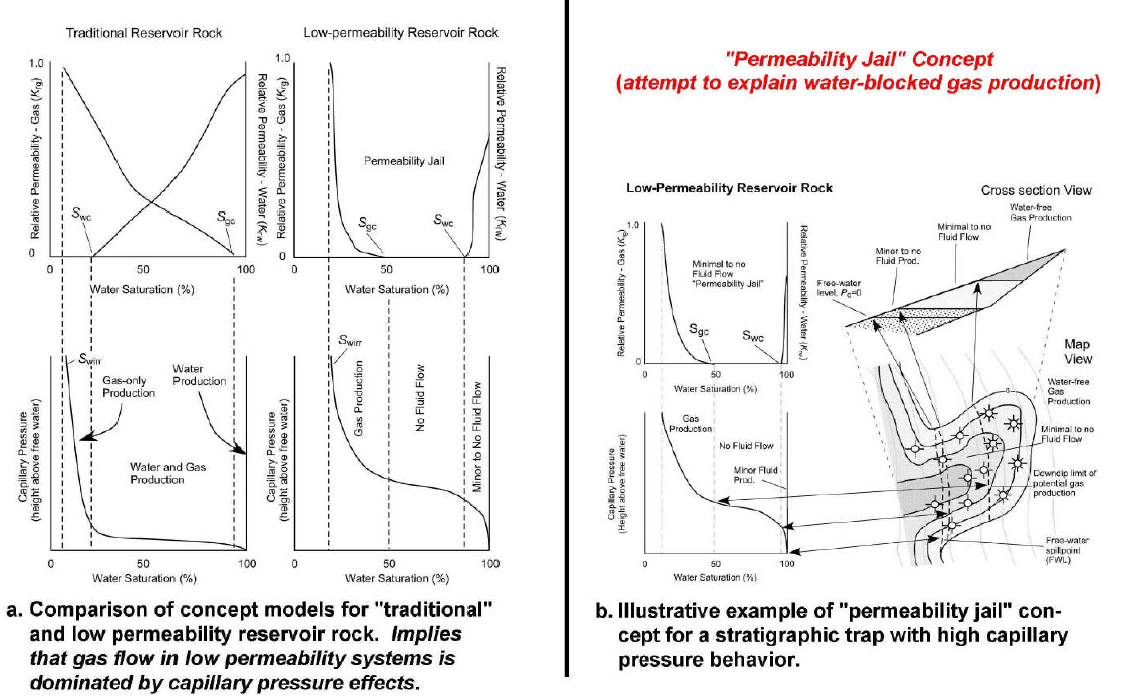
Blasingame (2008) describes the permeabiltiy jail as a useful concept, but states there must be other considersations such as stimulation and well placement. Academic literature has also suggested that capillary trapping of gas and water may occur in coal seam gas as well.
Field Observations
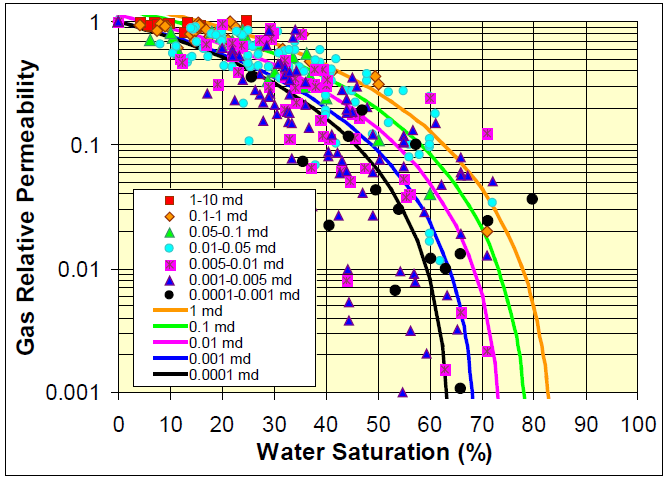
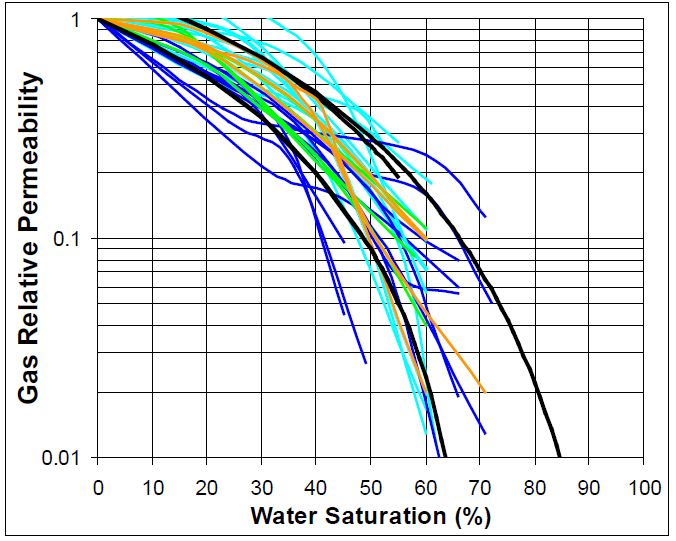
Cluff et al (2010) states this has only observed this phenomena in very low permeability formations, typically with absolute gas permeabilities less than 50 micro-Darcies. The plots below show that at any given water saturation, the relative permeability to gas tends to decrease with any decreasing absolute permeaibilty.
References
-
Cluff, Robert M., and Alan P. Byrnes. "Relative permeability in tight gas sandstone reservoirs-the" Permeability Jail" model." SPWLA Annual Logging Symposium. SPWLA, 2010.
-
Mo, S. Y., et al. "Effect of the drawdown pressure on the relative permeability in tight gas: A theoretical and experimental study." Journal of Natural Gas Science and Engineering 24 (2015): 264-271.