
Introduction
General speaking, modern low permeability systems are completed with horizontal well through to Multi-fractured horizontal wells (MFHW), and other various combinations. An idealized example of the MFHW is shown below:
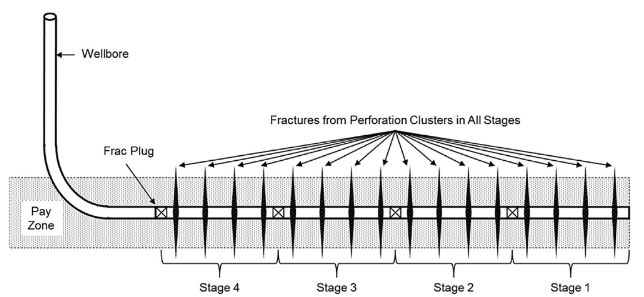
Both the micro- and macro-evolutions of completion designs toward high-intensity completions have led to a drastic reduction in breakeven production costs. For example:
|
|
2015 |
May 2019 |
|---|---|---|
|
Average North American Break-Even |
$68/Bbl |
$48/Bbl |
Cost effectiveness were attributed to a variety of micro and micro evaluations in completion designs, fracture stimulation, and even workflows.
The cost reductions have not been a result of a single innovation, or even just a few. As Pioneer Natural Resources explained in a paper presented the 2018 n(SPE) Annual Technical Conference and Exhibition, design teams must consider more than 20 different design parameters for a well’s completion, including:
-
Proppant and proppant intensity
-
Fluid type and amount
-
Crosslinked gels vs slickwater fracs
-
Energized fracs
-
-
Cluster spacing,
-
Stage length and
-
Well spacing
-
Multi-Well Pads
-
Continuous operation
According to Guo [2023] and others, the many of these types of wells are completed:
-
Using Cemented Sleeves (ball or coiled tubing activated)
-
Plug and Perf (or limited entry)
-
Pin Point Fracturing
References:
-
Hart Energy, Hartenergy.com , https://www.hartenergy.com/ep/exclusives/progression-completions-180330
-
B. Gou, Well Productivity Handbook: Vertical, Fractured, Horizontal, Multilateral, and Intelligent Wells, 2008