
Introduction
According to Cox, coal porosity has a significant impact on well performance. With all other factors being equal, wells with higher porosity exhibit:
-
Extended dewatering
-
Lower gas rates
-
Slower depletion
In conventional reservoirs, porosity can be based on either cores or well logs. However, coal porosity is far more difficult to determine as cleats can relax and rearrange slightly as a resulting of coring and retrieval. In the past, given the low porosity of coals it was difficult to determine as it was masked by factors such as coal density, ash content, and other materials.
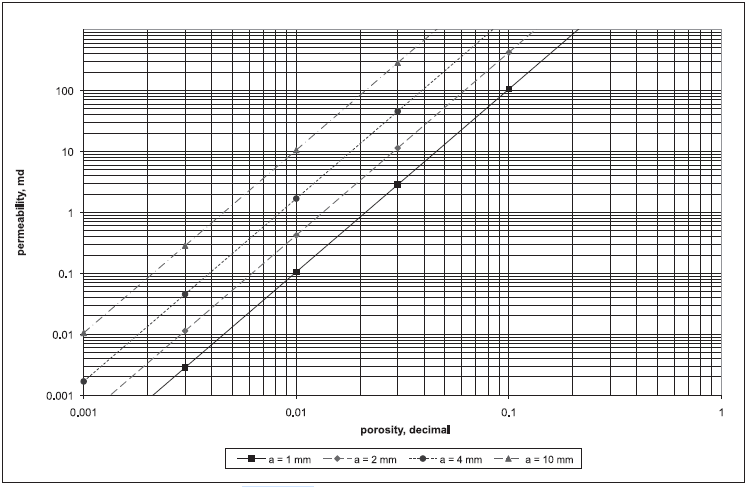
Cleat Porosity vs Permeability
The plot below shows a basic relationship of cleat permeability as a function of cleat porosity (and spacing)
Pseudo-Porosity for Coal
Although the mathematics is not shown here, if the following coals were analyzed as a sandstone reservoir, they would have the following equivalent values:
|
Basin |
Pseudo-Porosity ( % ) |
|---|---|
|
Northern Appalachian Basin |
59 |
|
Central Appalachian Basin |
50 |
|
Southern Appalachian Basin |
59 |
|
San Juan Basin |
55 |
|
Illinois Basin |
54 |
References:
-
Thakur, Pramod, Advanced Reservoir and Production Engineering for Coalbed Methane, 2017, Gulf Professional Publishing
-
Cox, Dave, PE 598: Coalbed Methane, 2001, Colorado School of Mines
-
John Seidle, Fundamentals of Coalbed Methane Reservoir Engineering, 2011 PennWell Corporation