
Introduction
Sorption data can be reported in two formats:
-
As Received
-
Contains impurities of moisture, ash etc
-
-
Dry-Ash-Free (DAF)
-
All impurities removed
-
Ash Content
Knowing the ash content of a coal is important in that is adsorbs little or no gas and hence dilutes the adsorption capacity of the whole coal. Additionally, the ash content of analysed samples do not necessarily represent the ash content of the entire coal seam and therefore adsorption capacity of the coal is best represented on a DAF basis (see further below).
Moisture Content
Moisture content of a coal is also an important measure. The moisture content of the coal includes extraneous or surface moisture (moisture that is part of the coal and held physically in capillaries). As shown by Scott (1993) and Bustin (2001), there is a well established trend of increasing moisture content with increasing coal rank.
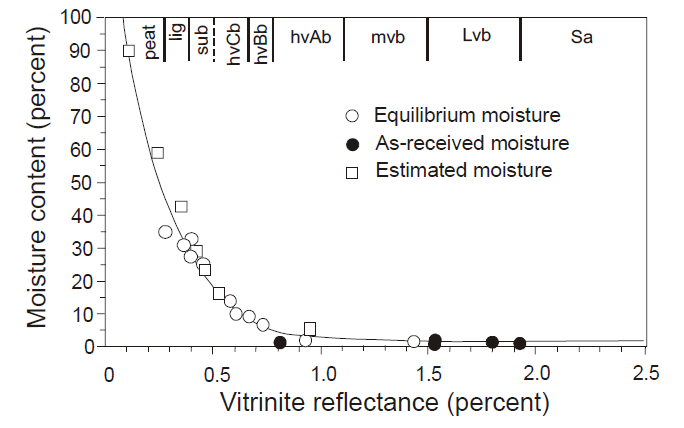
Additional information on ash and water content and relationship with isotherms can be found here .
Volatile Matter
Volatile matter is the weight loss of a sample from heating (excluding moisture). The volatiles can include hydrocarbons and non-hydrocarbon gases and tar.
Converting DAF and AR
Mathematically, the Langmuir volume must be corrected for ash and moisture content, but not the Langmuir pressure. The DAF Langmuir volume is calculated as shown below:
' aria-hidden='true'%3e %3cg transform='translate(167%2c0)'%3e %3cg transform='translate(-11%2c0)'%3e %3cg transform='translate(0%2c-118)'%3e %3cuse xlink:href='%23E1-MJMAIN-56' x='0' y='0'%3e%3c/use%3e %3cg transform='translate(750%2c-163)'%3e %3cuse transform='scale(0.707)' xlink:href='%23E1-MJMAIN-4C'%3e%3c/use%3e %3cuse transform='scale(0.707)' xlink:href='%23E1-MJMAIN-2C' x='625' y='0'%3e%3c/use%3e %3cuse transform='scale(0.707)' xlink:href='%23E1-MJMAIN-44' x='904' y='0'%3e%3c/use%3e %3cuse transform='scale(0.707)' xlink:href='%23E1-MJMAIN-41' x='1668' y='0'%3e%3c/use%3e %3cuse transform='scale(0.707)' xlink:href='%23E1-MJMAIN-46' x='2419' y='0'%3e%3c/use%3e %3c/g%3e %3cuse xlink:href='%23E1-MJMAIN-3D' x='3300' y='0'%3e%3c/use%3e %3cg transform='translate(4079%2c0)'%3e %3cg transform='translate(397%2c0)'%3e %3crect stroke='none' width='4312' height='60' x='0' y='220'%3e%3c/rect%3e %3cg transform='translate(885%2c820)'%3e %3cuse xlink:href='%23E1-MJMAIN-56' x='0' y='0'%3e%3c/use%3e %3cg transform='translate(750%2c-163)'%3e %3cuse transform='scale(0.707)' xlink:href='%23E1-MJMAIN-4C'%3e%3c/use%3e %3cuse transform='scale(0.707)' xlink:href='%23E1-MJMAIN-2C' x='625' y='0'%3e%3c/use%3e %3cuse transform='scale(0.707)' xlink:href='%23E1-MJMAIN-41' x='904' y='0'%3e%3c/use%3e %3cuse transform='scale(0.707)' xlink:href='%23E1-MJMAIN-52' x='1654' y='0'%3e%3c/use%3e %3c/g%3e %3c/g%3e %3cg transform='translate(60%2c-687)'%3e %3cuse xlink:href='%23E1-MJMAIN-31' x='0' y='0'%3e%3c/use%3e %3cuse xlink:href='%23E1-MJMAIN-2212' x='722' y='0'%3e%3c/use%3e %3cuse xlink:href='%23E1-MJMATHI-61' x='1723' y='0'%3e%3c/use%3e %3cuse xlink:href='%23E1-MJMAIN-2212' x='2475' y='0'%3e%3c/use%3e %3cuse xlink:href='%23E1-MJMATHI-77' x='3475' y='0'%3e%3c/use%3e %3c/g%3e %3c/g%3e %3c/g%3e %3c/g%3e %3c/g%3e %3c/g%3e %3c/g%3e %3c/svg%3e)
Where:
VL,DAF = dry, ash-free Langmuir volume constant scf/ton
VL,AR = in-situ (as received) Langmuir volume constant, scf/ton
a = ash mass fraction
w = equilibrium moisture mass fraction
Coals properties can vary from bedding plane to bedding plane. Consequently, even in a single seam, sorption isotherms should be compared on a dry, ash-free or a dry, mineral-matter free (dmmf) basis. The DAF isotherm is always higher than the AF Isotherm.
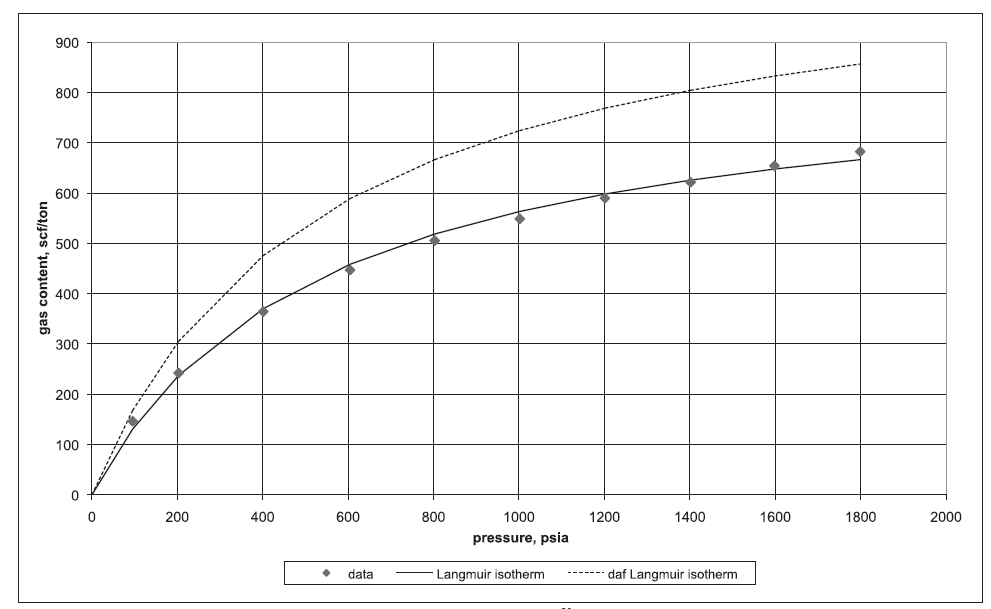
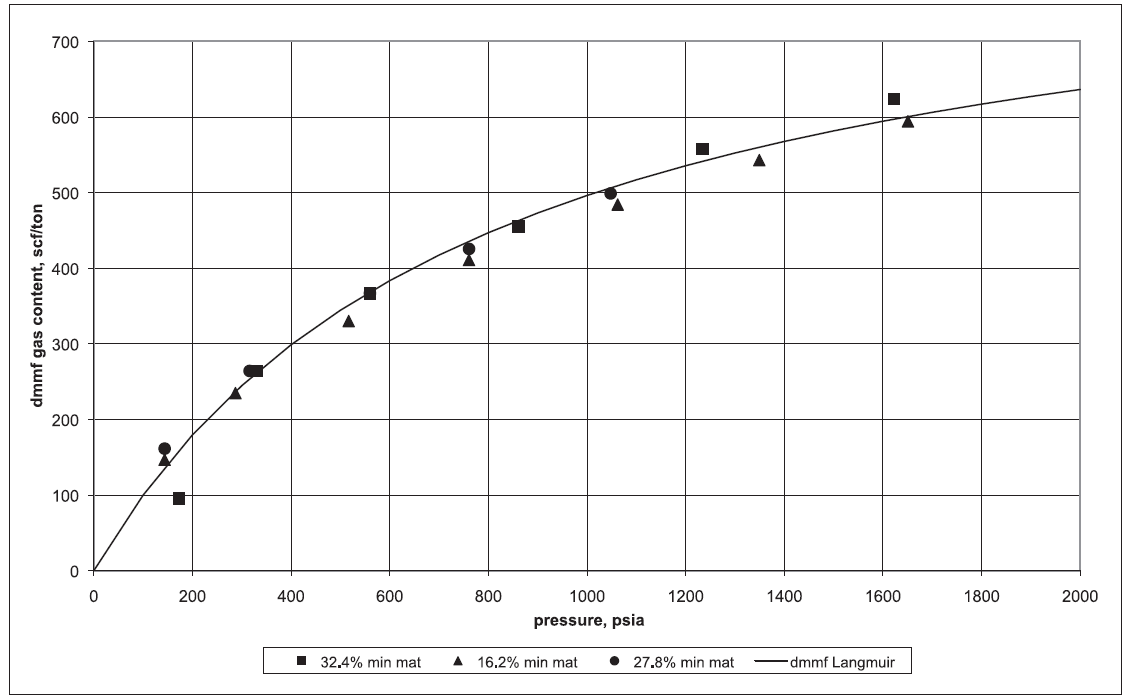
When comparing different seams, the AF isotherm is useful. If the organic components of a given seam were uniform, all daf or dmmf isotherms from that seam should plot on top of one another. In practice, however, same-seam isotherms vary due both to errors inherent in any laboratory procedure and to the heterogeneous nature of coal. Slight differences in maceral distributions of coal samples, for example, will affect gas storage properties. Nonetheless, comparison of multiple DAF isotherms from a given project provides a quick quality check on laboratory results. The figure below shows the various DAF isotherms for different samples taken from the Cedar Hill Field of the San Juan Basin
References:
-
John Seidle, Fundamentals of Coalbed Methane: Reservoir Engineering, 2011, PennWell Corporation.
-
Bustin, R. M. Geology & Some Engineering Aspects of Coalbed Methane 2001 CBM Solutions.